What is a High-Control Religion?

Many people who have had a difficult religious experience often find themselves asking the same questions:
Was this normal?
Was it just strict or did it cross the lines into abuse?
Was it a cult?
Why does it still affect me years later?
The answers aren't always straightforward.
Not every religious group is a cult. Not every disciplined religious environment is harmful. Many people have meaningful spiritual experiences, form lifelong friendships, and find genuine comfort and belonging through faith communities.
And yet, some religious environments exert a level of influence and control that extends far beyond spiritual guidance.
These environments are often called high-control religions.
And if you’ve had a traumatic religious experience, understanding how high-control religions work is one of the most important steps in recovering your sense of self, reconnecting with your own wisdom, and reclaiming your sovereignty.
In This Article
-
What a high-control religion is and how it differs from a healthy faith community
-
The five patterns many high-control religions use to gain and maintain influence
-
Why religious trauma can be so confusing to recognize and untangle
-
How these experiences shape your relationship with yourself, others, and the sacred
-
The first step toward reclaiming your inner authority and rebuilding from the inside out
My Story
I was born into a mainstream cult that is well known for their strict rules and their practice of shunning anyone who refuses to follow them. As a child I yearned for a normal life: to go to football games, have sleepovers with school friends, and celebrate holidays.
I developed a very strong rebel identity to cope. When I was 19, I chose to leave the organization (and I was shunned for it). I was finally free to do what I wanted! I assumed finally being able to do what I wanted and live on my own terms would change everything.
It wasn’t until I was in my early 30’s that I hit the truth of my experience hard: I was out, but I wasn't free.
I had left the religion behind, but many of the patterns and behavior adaptations remained.
I still questioned, criticized and judged myself as not good enough.
I felt full of shame.
I constantly looked outside myself for answers and ignored my own wisdom.
I still carried beliefs about who I was and how much life was available to me.
I began to want healing just as much as I had dreamed about freedom as a young girl. It took me down a long path of transformation that continues today.
Along the way, I realized that healing didn't begin with fixing myself. It began with understanding how high-control religion actually works.
What Is a High-Control Religion?
A high-control religion is a belief system that positions itself as the authority over what people believe, how they behave, who they associate with, and how they make decisions.
The issue isn't faith.
The issue is control.
High-control religions discourage the development of inner wisdom and discernment, create dependency on external authority, and use consequences to enforce compliance.
The goal may be spiritual growth but the result is often the surrender of personal sovereignty.
Religion, High-Control Religion, and Cults
People often assume there are only two categories:
Religion.
Cult.
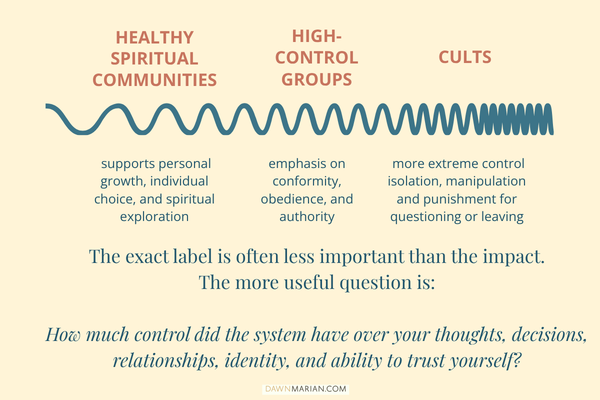
In reality, there is a spectrum.
Healthy religious communities generally support personal growth, individual choice, and spiritual exploration.
High-control religions place greater emphasis on conformity, obedience, and authority.
Cults typically represent the far end of the spectrum, where control becomes more extreme and involves isolation, manipulation, and severe consequences for questioning or leaving.
The exact label is often less important than the impact.
The more useful question is:
How much control did the system have over your thoughts, decisions, relationships, identity, and ability to trust yourself?
The Mechanics of High-Control Religion
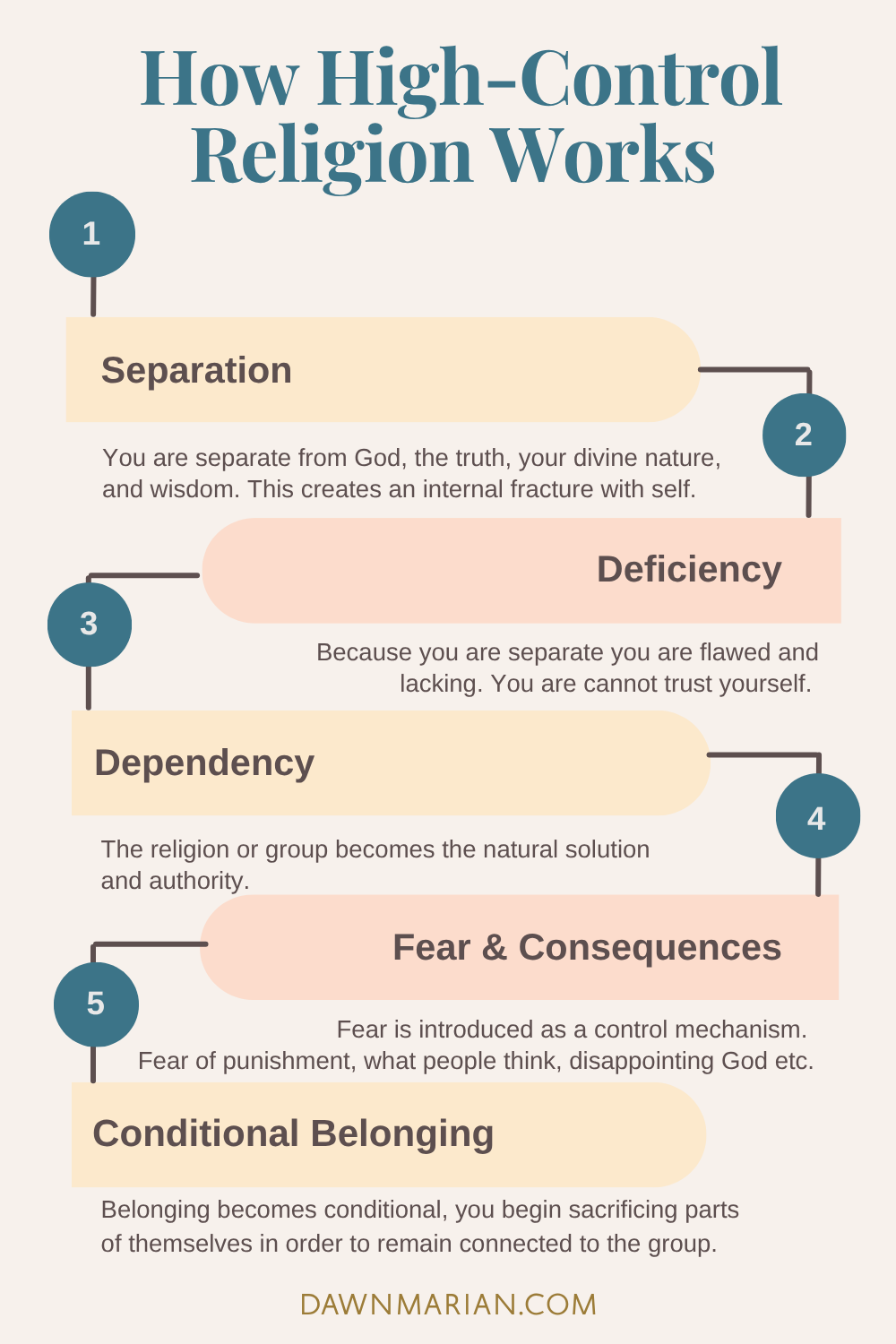
While every group is different, many high-control religions operate through a similar pattern. Here's a simple overview of that process. As you read through the rest of this article, we'll explore each stage in more depth and how these patterns can gradually shape a person's relationship with themselves, others, and the sacred.
Let's look at each step more closely.
1. Separation
The first message is often some version of:
You are separate.
Separate from God.
Separate from truth.
Separate from your own divine nature.
Separate from wisdom.
Whether explicit or implied, the message is that something essential has been lost and must be restored to wholeness and union.
2. Deficiency
The second message follows naturally.
Not only are you separate, but because of this separation, there is something wrong with you.
You are flawed.
You are sinful.
You are broken.
You cannot trust yourself.
Your mind is suspect.
Your body is dangerous.
Your desires are questionable.
Your emotions are unreliable.
Over time, the relationship with yourself begins to erode. You become separate from yourself and begin to question your own sovereignty.
3. Dependency
Once separation and deficiency are established, the religion or spiritual practice becomes the solution.
The bridge.
The path.
The authority.
The answer.
The system doesn't simply offer guidance. It positions itself as the only legitimate way back to what was lost. Connection, truth, belonging and even your relationship with the divine become something it claims to mediate.
The moment you accept that premise, you enter into a new power dynamic. Your own inner knowing is no longer the primary authority. Instead, you learn to look outside yourself for permission, certainty and direction.
From there, everything becomes conditional.
Connection becomes conditional upon participation.
Belonging becomes conditional upon compliance.
Truth becomes something the system defines.
Authority shifts from within to without.
Your relationship with the divine and yourself become something the system mediates.
4. Fear and Consequences
To reinforce the system and the authority of the high-control religion, fear is often introduced.
Fear of punishment.
Fear of exclusion.
Fear of disappointing God.
Fear of being wrong.
Fear of what others will think.
Fear of what will happen when you die.
Fear is a powerful motivator. Our nervous systems are wired to detect threat and prioritize survival. High-control religions often tap into our deepest human fears: the fear of rejection, the fear of punishment, the fear of uncertainty, and ultimately, the fear of death.
We are biologically wired for belonging because, for most of human history, being cast out from the tribe could mean death. We also seek certainty in the face of life's biggest questions. When a system suggests that your safety, your relationships, your purpose, or even your eternal future depend on staying within its boundaries, fear becomes a powerful force for maintaining control.
Whether the consequence is eternal damnation, the loss of community, public shame, or subtle social pressure, the message becomes clear:
Stay in line or there will be consequences.
5. Conditional Belonging
When we are learning about high-control religion and how to heal from religious trauma, this may be the most important concept to understand.
Human beings long for connection.
Love.
Purpose.
Meaning.
Safety.
A relationship with what is sacred.
These aren't weaknesses. They're deeply human needs.
We are biologically wired for belonging. For most of human history, being separated from other humans could mean losing protection, resources, and ultimately, our lives. Our nervous systems still carry that ancient blueprint, making connection feel essential to survival.
The problem isn't our need for belonging. The problem arises when belonging becomes attached to obedience.
When acceptance, love, and community are made conditional, people begin sacrificing parts of themselves in order to remain connected. They learn to silence their questions, distrust their intuition, suppress their emotions, and abandon parts of their authentic identity to preserve the relationship.
Over time, the cost becomes profound. The connection to the group is preserved, but the connection to oneself is gradually lost.
This, in itself, is traumatic.
Why Religious Trauma Can Be So Confusing
One of the biggest challenges in recovering from a high-control religion is that there is often genuine good woven into the harm.
You may have experienced community. Hope. Love. Friendship. Meaning.
Moments of deep spiritual connection and even transcendence.
It is important to acknowledge this. High-control religions rarely rely on fear and control alone. They also offer experiences that meet deeply human needs and can feel profoundly meaningful.
This is what makes recovery so confusing. It is possible for something to have been both deeply nourishing and deeply harmful. Recognizing the harm does not erase the good you experienced, and appreciating the good does not excuse the harm.
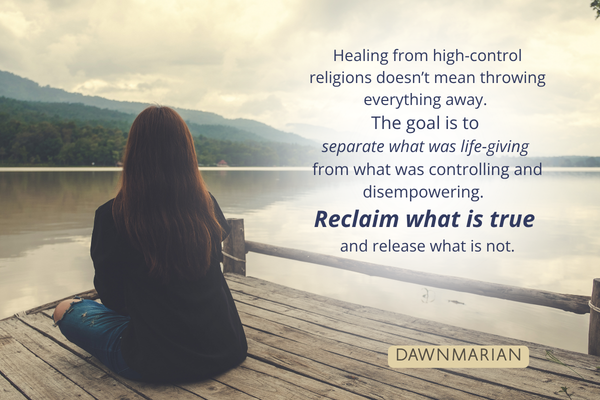
Healing doesn't require throwing everything away. It invites us to discern what was life-giving from what was controlling, to reclaim what is true, and to release what no longer serves us.
Holding both realities at once is often one of the most important steps toward healing.
The Real Cost of High-Control Dynamics
High-control religions don't simply dictate beliefs.
They shape relationships.
Identity.
The nervous system.
The ability to trust oneself.
Many people leave physically long before they leave emotionally, mentally, or spiritually.
This is why recovery often involves more than changing beliefs.
It involves rebuilding your relationship with yourself.
Learning to trust your own experience.
Learning to trust your body.
Learning to trust your emotions.
Learning to trust your inner knowing.
Learning to become the author of your life.
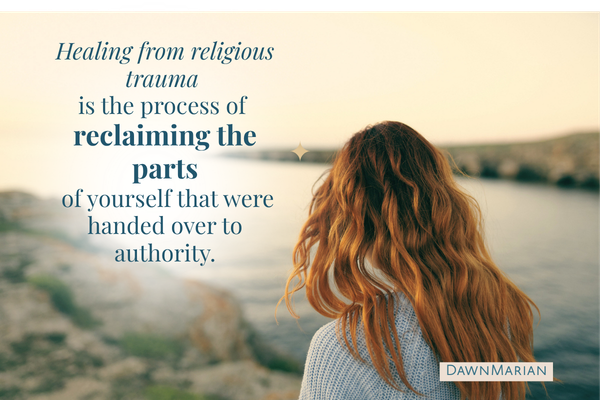
In many ways, healing is the process of reclaiming the parts of yourself that were handed over to authority.
Taking Your Power Back
At its core, this is a conversation about power.
High-control systems teach us that wisdom, truth, and authority live outside of us. The more we doubt ourselves, the more dependent we become on the system.
Eventually, the external authority becomes an internal voice. We begin monitoring ourselves, judging ourselves, and keeping ourselves in line, even after we've left.
Understanding this isn't about assigning blame or making ourselves wrong.
It's about recognizing where your power has been handed over so you can consciously take it back.
We can stop asking:
"What's wrong with me?"
And begin asking:
"What happened to me?"
That shift can change everything.
Understanding how control was used to disempower you is the beginning of reclaiming yourself.
It can help you to reconnect with your own wisdom, rebuild trust in yourself, and begin rebuilding your life from the inside out.
The Heart of It
- High-control religions don't just shape what you believe. They gradually shape how you relate to yourself.
- Many systems follow a similar pattern: separation, deficiency, dependency, fear, and conditional belonging.
- Understanding these patterns can help you replace self-blame with self-compassion and clarity.
- Healing from religious trauma isn't about rejecting your experience. It's about reclaiming your inner wisdom, discernment, and sovereignty.
- Recovery begins the moment you stop asking, "What's wrong with me?" and start asking, "What happened to me?"
Continue the Journey
If this article helped you recognize the patterns of a high-control religion, these articles will guide you through the next steps of recovery.
→ 7 Signs of Religious Trauma
Learn how these patterns may still be affecting your thoughts, emotions, relationships, and nervous system today.
→ Was I in a Cult? 20 Questions to Ask
Explore the questions that can help you distinguish between a strict religious environment and one that crossed the line into high-control or cult-like dynamics.
→ The Four Stages of Religious Trauma Recovery
Discover the healing journey from survival and stabilization to rebuilding trust in yourself and creating a life rooted in your own inner authority.