Hypervigilance After Religious Trauma

What Is Hypervigilance?
If you've spent any time learning about trauma or nervous system healing, you've probably come across the word hypervigilance. Hypervigilance is something we hear about often in conversations about trauma, but it can operate on many different layers, some much more subtle than others.
At its simplest, hypervigilance is a heightened state of alertness. Your nervous system is paying close attention to your environment, other people or your own internal experience for signs that something might be wrong or that danger might be coming.
When we hear "scanning for danger," it's easy to imagine someone constantly looking over their shoulder, checking the exits when they enter a room or jumping at every unexpected sound like Katniss in The Hunger Games or Jason Bourne in The Bourne Identity. Hypervigilance can certainly look like that.
But it can also be much more nuanced and under the surface.
✦ In This Article
- What hypervigilance is and why it develops
- How hypervigilance can show up in subtle ways
- How religious conditioning can become internalized as hypervigilance
- How hypervigilance can continue affecting you long after you've left
- How healing can free up the energy once used to monitor for danger
Hypervigilance Is More Subtle Than You Might Think
Hypervigilance goes beyond constantly scanning your environment for danger. More subtle manifestations may be that you constantly worry about what other people think about you or how you appear. You may notice every shift in someone's voice, facial expression or mood and make assumptions about what those changes mean.
But in high-control systems, there can be another layer to this. You're not only noticing what is happening around you. You're using that information to adjust your own behavior in an effort to stay in favor, stay compliant and ultimately, stay safe.
You notice a change in someone's expression and become more agreeable. You sense disapproval and stop saying what you were going to say. You pick up on what is expected of you and adjust yourself to meet that expectation. Over time, this can become so automatic that you don't even realize you're doing it.
This is one of the ways religious conditioning can become internalized as hypervigilance. Even after you've left the system, you may still be closely monitoring other people and adjusting yourself in response to what you perceive they want or expect from you.
Why Hypervigilance Happens
Our bodies are designed to keep us safe. For our ancestors, survival required being constantly alert to potential threats from wild animals, the natural world, weather and other people. We developed an acute ability to sense when danger might be approaching and respond quickly enough to protect ourselves.
That capacity is a good thing. It has helped keep humans alive and evolving. Hypervigilance isn't something we need to feel wrong about or treat as the enemy. The problem is what happens when that natural protective mechanism becomes highly conditioned around fear.
When Hypervigilance Becomes Internalized
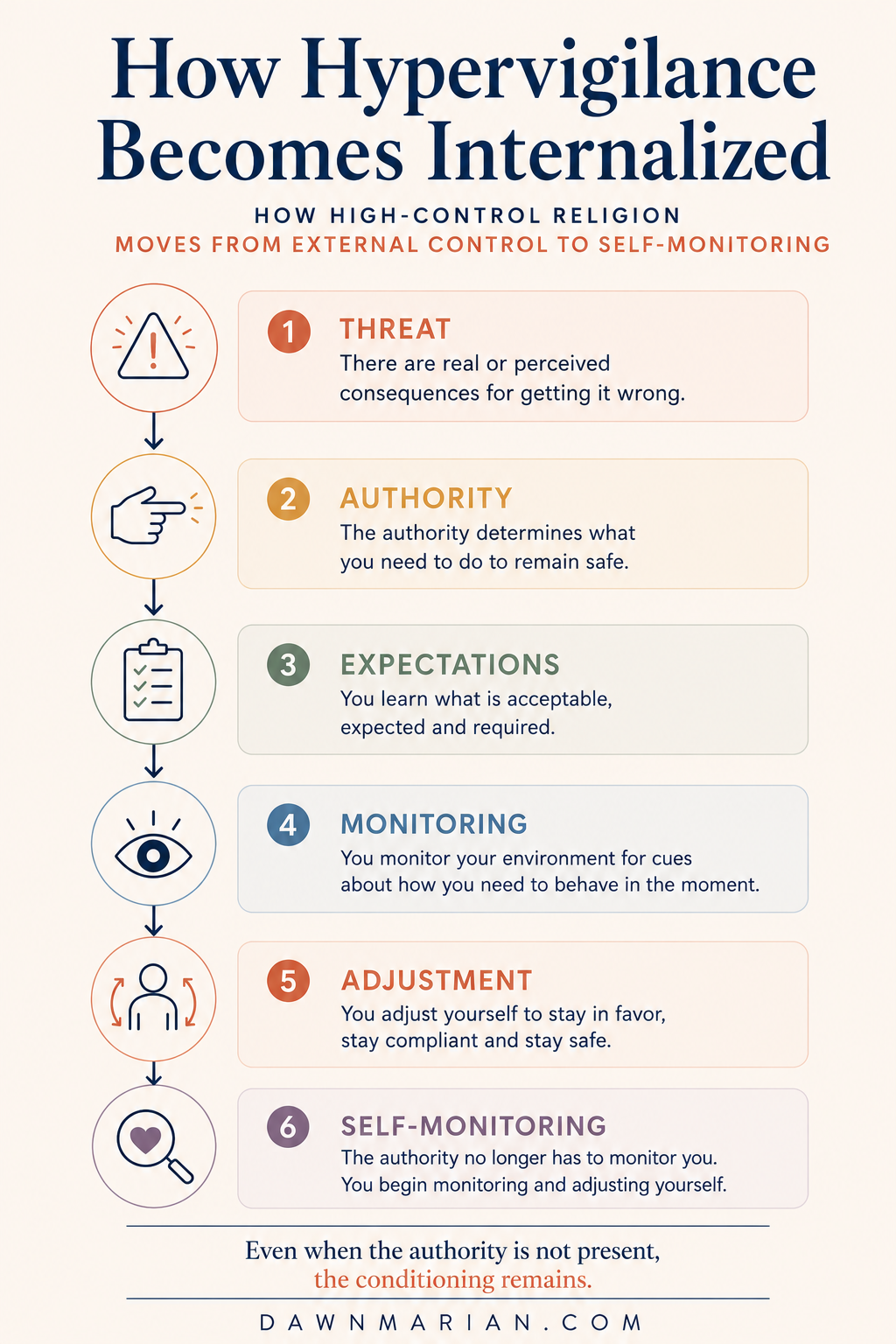
In a high-control system, there is both a threat and an authority that determines what you need to do to remain safe from that threat. The threat might be disapproval or punishment, loss of belonging, spiritual consequences, loss of salvation or even death. The authority might be God, a religious organization, a leader, guru or the group itself.
The authority doesn't simply tell you what to believe. It teaches you what you must do to stay on the safe side of the threat.
You learn the expectations of the system. You learn what is acceptable and what isn't. You learn what keeps you in favor and what might lead to disapproval, punishment or other consequences.
You begin to monitor.
At first, that monitoring may be focused outward. You pay close attention to the people around you and the authority figures within the system. You notice their reactions. You learn to recognize approval and disapproval. You become increasingly skilled at picking up on the cues, both verbal and nonverbal, that tell you whether you are meeting the expectations.
Then you adjust.
You change what you say, how you behave or what parts of yourself you allow other people to see. You learn how to stay in favor, stay compliant and ultimately stay safe.
Over time, you don't necessarily need the authority to monitor you anymore.
You begin monitoring yourself.
The expectations of the system have become so deeply ingrained that you know what you're supposed to say, think, feel and do. You anticipate what might bring approval or disapproval and adjust yourself accordingly.
This is where hypervigilance becomes internalized. What began as paying close attention to an external threat can become a nearly automatic process of watching and adjusting yourself in order to remain safe.
How Hypervigilance Continues After You Leave a High-Control Religion
Leaving a high-control religion removes you from the external system, but it doesn't automatically remove the monitoring system that was conditioned inside of you.
You may no longer believe what you were taught. You may no longer answer to the same authority or follow the same rules. You may even have been out for years. But the habit of constantly monitoring yourself and the people around you can continue long after you've left.
It can show up in ordinary moments that don't seem connected to your religious experience at all.
You send someone a message and they don't respond right away. You immediately start second-guessing yourself. Did I say too much? Did I say something wrong? Did they read it in the wrong tone and take it the wrong way? Are they upset with me?
Someone's energy seems different and you immediately wonder if you've done something wrong.You go through the last interaction in your mind to see what you could have possibly done that was offending.
You disagree with someone but find yourself quickly changing the direction of your comments when you sense they aren't happy with your response.
You walk into a room and immediately begin reading the people in it. Who seems comfortable with you? Who doesn't? What is the mood? What version of you is going to work best here?
You may find yourself asking questions you don't even realize you're asking because they’ve become so normal:
Am I doing this right?
Am I allowed to do this?
What will people think?
Is someone disappointed in me?
Did I say too much?
Am I safe being fully myself here?
None of these situations necessarily involve the religion you left. But the underlying mechanism can be the same. You're still scanning for cues, anticipating approval or disapproval and adjusting yourself in response.
The external authority may be gone, but the monitoring can continue.
When Hypervigilance Lives in the Body
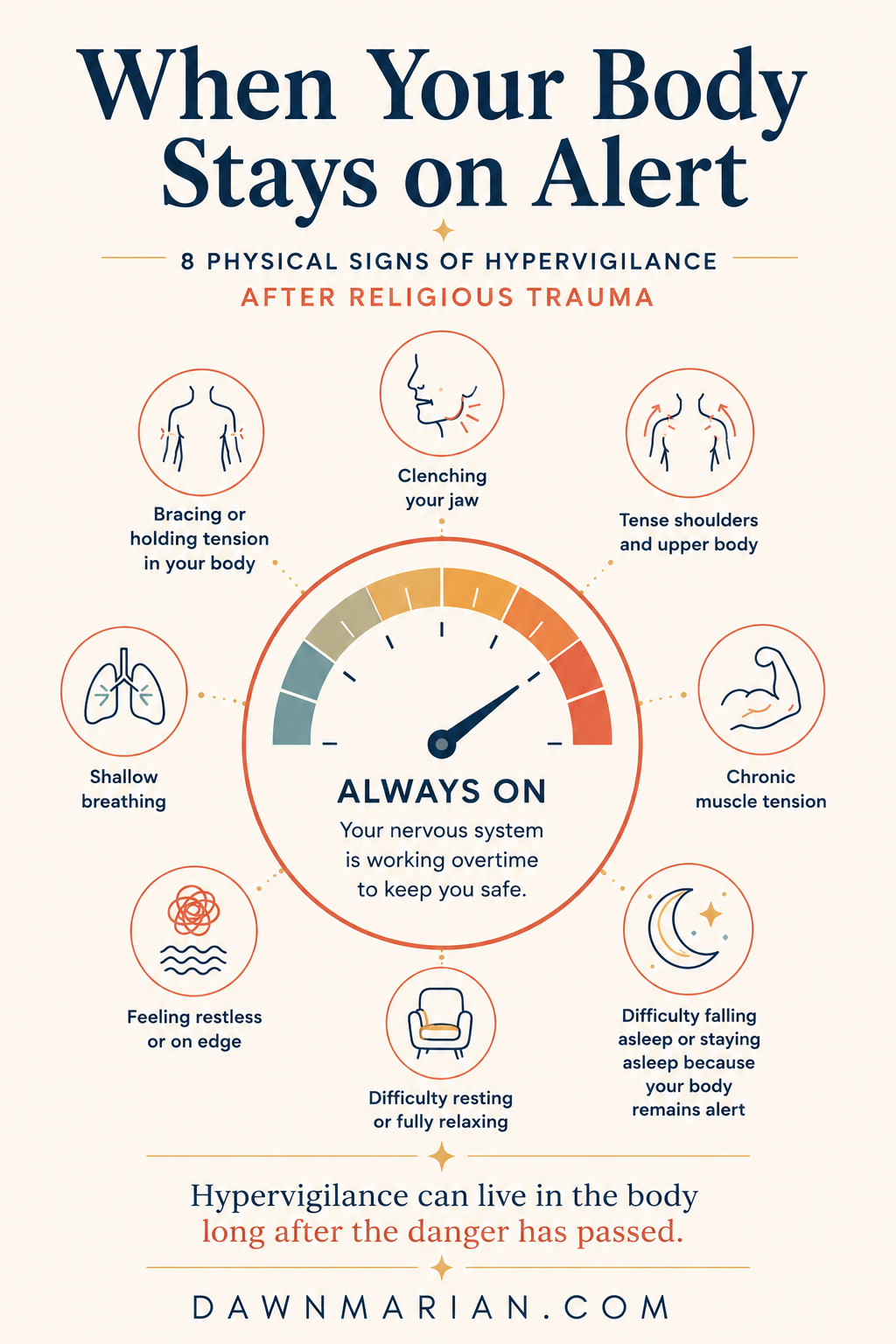
Hypervigilance isn't only a mental process. Your body can also remain prepared for danger, even when there is no immediate threat.
Physically, this might look like:
- Bracing or holding tension in your body
- Clenching your jaw
- Holding tension in your shoulders and upper body
- Chronic muscle tension
- Shallow breathing
- Feeling restless or on edge
- Difficulty resting or fully relaxing
- Difficulty falling asleep or staying asleep because your body remains alert
When you've spent years monitoring for danger, your body can become accustomed to being ready to respond. Even after you've left the environment that conditioned the hypervigilance, your body may still be preparing for a threat that is no longer there.
Healing Hypervigilance
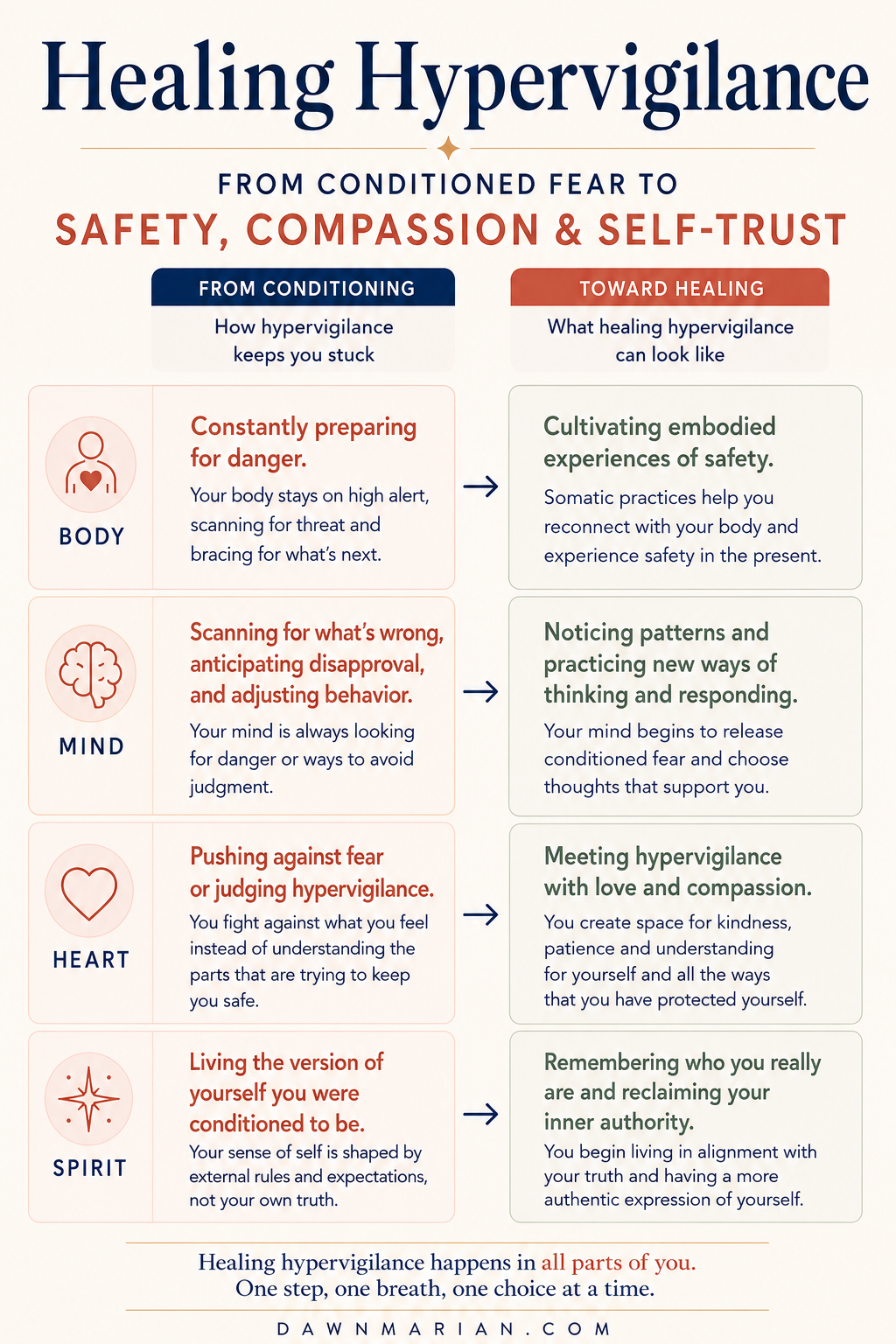
Healing hypervigilance is about gently helping your system remember what it feels like to be safe.
When your body has spent years preparing for danger, it may take time for it to recognize that the threat is no longer present. Somatic practices can help you reconnect with your body, notice where you're still scanning for danger and help you cultivate embodied experiences of safety. This might include mindfulness, yoga, bodywork, Embodied Processing or other body-based approaches that help you become more present with what is happening inside of you.
Religious conditioning affects our whole system, and healing can happen there too.
Our minds can begin releasing conditioned fear and learning new ways of thinking. Instead of automatically scanning for what's wrong, anticipating disapproval and adjusting ourselves around other people's expectations, we can begin noticing these patterns and practicing a different response.
We can make space for love and compassion. Rather than fighting against hypervigilance or pushing it away, we can develop compassion for the parts of us that learned to constantly stay alert in order to keep us safe.
Our spirits can remember the truth of who we are beneath the conditioning. We can reconnect with our own inner authority and sovereignty and begin living from who we are rather than who we were conditioned to be.
I believe healing from religious trauma requires a whole-system approach. We're not trying to change one symptom or convince ourselves that we're safe. We're helping the body, mind, heart and spirit recover from the conditioning and rebuilding our relationship with ourselves from the inside out.
What Happens When We Stop Using All That Energy to Look for Danger?
Healing hypervigilance isn't about getting rid of our ability to notice what's happening in our environment. Underneath it is a highly developed awareness that can pay attention, pick up on subtle cues and respond quickly.
The question becomes whether that capacity has to remain organized around danger.
What if we can repurpose it?
Instead of constantly scanning for what might go wrong or what might be wrong with us, we can use that same awareness to notice what is safe, beautiful, loving and possible.
We can look for the good in people. We can scan for positive experiences and opportunities. We can notice the places where we feel safe and lean into them. And we can become increasingly aware of the ways we can love ourselves more and respond by choosing to do so.
As our system comes back into balance, the capacity to be hypervigilant can also return to its natural purpose. Our awareness of subtle cues can alert us when we are actually in danger or when something about a person or situation isn't right. Instead of being on high alert all the time, that heightened awareness becomes information we can pay attention to when we need it.
As we learn to trust ourselves again, that sensitivity can also become a gateway into our own intuition and inner knowing.
We don't have to stop noticing. We can learn to trust what we notice without constantly organizing our lives around fear.
Continue Your Journey
Embodied Processing
Learn how Embodied Processing can help you work with emotions, nervous system responses and survival patterns held in the body.
LEARN ABOUT EMBODIED PROCESSING →
A Whole-System Approach to Healing Religious Trauma
Explore how healing the body, mind, heart and spirit can support you as you rebuild from the inside out.
EXPLORE WHOLE-SYSTEM HEALING →
5 Signs of Hypervigilance You Might Not Recognize
Hypervigilance isn't always obvious. Learn five subtle ways it can show up in your thoughts, relationships and everyday life.