7 Signs of Religious Trauma

I had been out for nearly a decade when I found myself sitting in front of a computer late one night, heart racing as I slowly typed J-E-H-O-V-A-H-S W-I-T-N-E-S-S-E-S into Internet Explorer.
The year: 2002. The internet was still *brand spanking new*.
20 results came back. 2 were official JW sites and the remaining 18 were from folks who called themselves cult survivors.
Cult survivors?
I hadn’t even considered I had been in a cult.
I was trying to understand why there was always a low grade hum of anxiety running underneath everything I did ever since I left the Jehovah’s Witnesses organization.
Why I kept trying to prove my worth to everyone, and always felt like I was constantly failing.
Why I self-sabotaged even when I knew I was bright and capable.
And why, on late nights like this, did my mind circle back to what felt like unfinished business about my experience growing up as a Jehovah’s Witness.
I had left the religion, but it hadn’t left me.
At the time, I didn't have language for what I was experiencing.
Today, I do.
It was religious trauma.
And if you're reading this article, there's a good chance that some part of you is asking similar questions and feeling like you don’t fully belong to yourself.
If so, you're not alone.
In This Article
-
What religious trauma is and why its effects often continue long after leaving a high-control religion.
-
How religious trauma can shape your relationship with yourself, others and the world around you.
-
Seven common signs that you may still be carrying its impact.
-
Why the lasting effects of religious trauma are intelligent survival adaptations rather than personal failures.
First, let’s define religious trauma. What is it, and how does it hold us back even when we leave a religious or spiritual group?
What Is Religious Trauma?
Religious trauma is the emotional, psychological, physical, and spiritual impact of harmful religious experiences or high-control belief systems.
It can develop when fear, shame, guilt, control, punishment, or the suppression of your authentic self become woven into your relationship with faith, community, authority, or even God.
Religious trauma doesn't only affect what you believe. It can affect how you think, feel, relate to others, make decisions, trust yourself, and move through the world.
Many people assume that once someone leaves a harmful religious environment, the effects will disappear. But the patterns often continue long after the beliefs themselves have changed. Here's a quick overview of the seven signs we'll explore together. You may recognize yourself in one, or several. The signs below are some of the most common ways religious trauma shows up in everyday life.
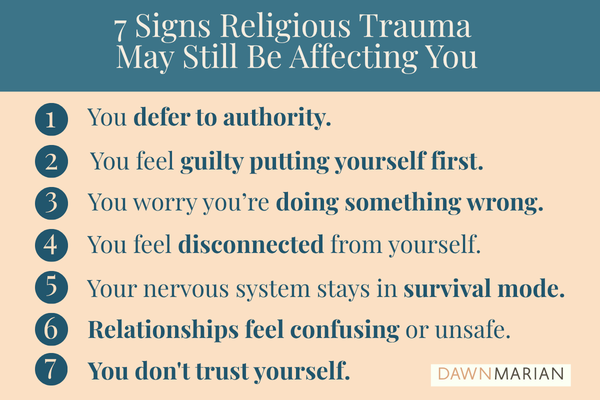
1. You Defer to Authority
You look to others for answers, guidance, permission, or validation before trusting your own judgment.
Growing up, the single women in my congregation didn't make major decisions on their own. Decisions about moving, furthering education, accepting a job opportunity, dating, or making significant life changes were always discussed with the elders first.
The assumption was that these specially chosen men knew better, had greater spiritual wisdom, and a direct line to Jehovah (or at least the next level of hierarchy).
Looking back, it's not surprising that we learned that wisdom flowed from the top down rather than from within.
Why it happens: High-control religious environments teach you to distrust your own instincts and rely on external authority.
2. You feel guilty for asking for your needs to be met or putting yourself first
We didn't celebrate holidays as Jehovah’s Witnesses, and money was tight. As a result, gifts were rare.
When I was around twelve years old, my mom hosted a home decorating party. As the hostess, she received a beautiful Chinese lacquered pot as a gift. I loved it. I wanted it desperately.
I remember pressuring her to give it to me. Reminding her that we didn't celebrate birthdays or Christmas and I never received gifts. I played the poor me fiddle in the way that pre-teens do. Reluctantly, she gave it to me.
For years, that little lacquered pot was a container for my guilt. I felt guilty that I had wanted it so badly. Ashamed that I had made my mother feel bad about our finances. Wrong for asking for something just because I wanted it.
Looking back, I see a twelve-year-old child who wanted something beautiful and had the self-advocacy to ask for it. What strikes me now isn't the pot itself or the story of mothers and daughters caught in a web of scarcity. It's how quickly desire became guilt.
Resting when you're tired. Saying no. Setting a boundary. Making time for fun. Spending money on yourself. Exploring your sexuality. Investigating new ideas without committing to them. Making a decision that serves your well-being.
If these things trigger guilt, anxiety, or self-judgment, you may be carrying messages that taught you your needs were less important than obedience, service, sacrifice, or the expectations of others.
Many survivors of high-control religions learn that having needs, wants, preferences, or desires is selfish and wrong. Over time, even healthy self-interest can trigger shame.
Why it happens: In many high-control religious environments, guilt and shame are used to encourage compliance and discourage individuality. Caring for yourself and advocating for your needs can be labeled selfish, even when it's healthy and necessary.
3. You Constantly Worry You're Doing Something Wrong
You second-guess your words, your choices, your motives, and even your thoughts. You may spend hours analyzing your actions and replaying conversations because you’re afraid you’ve made a mistake.
Maybe you lie awake at night reliving a conversation with your boss, convinced you said something stupid and will be fired for your incompetence.
A friend doesn't reply to a text?
It must be something I said.
Someone seems distant and a little cold?
You wrack your brain over your last encounter.
What did I do wrong?
Why it happens: In high-control religious environments, mistakes often carry consequences far beyond the mistake itself. Members may fear judgment, loss of status, social rejection, spiritual failure, or even divine punishment. The nervous system learns to scan constantly for signs of disapproval, rejection, or punishment.
In a system where being right is rewarded and being wrong carries heavy consequences, it's easy to lose the understanding that mistakes are a normal part of being human.
4. You Feel Disconnected From Yourself
You know who you were supposed to be, and you're definitely not that anymore, but you're not sure who you actually are.
Or perhaps the gap between who you are inside and how you're living feels wide and difficult to bridge.
This disconnection doesn't only show up as confusion about your identity. It can also show up as feeling disconnected from your body, being emotionally shut down, difficult playing or resting, and feeling invisible.
Many spiritual abuse survivors become highly identified with their thinking mind. They analyze, explain, rationalize, and try to figure everything out intellectually while feeling disconnected from what is happening deeper within them.
When I work with clients in the Akashic Records, one of the most common questions I hear is surprisingly simple:
"Who am I, really?"
Beneath the questions about purpose, relationships, career, or spirituality is often a deeper longing to reconnect with the self that existed before all the conditioning, expectations, and roles they learned to perform.
Why it happens: In high-control religious environments, belonging often depends on conformity. Over time, your authentic self can become buried beneath expectations about who you should be, what you should believe, how you should feel, and how you should live.
5. Your nervous system feels stuck in survival mode
One of the things many people don't realize is that religious trauma isn't just about beliefs or what happens in our minds. It's something our bodies experience.
When fear, judgment, punishment, scrutiny or the threat of losing belonging become a regular part of life, the nervous system adapts. It learns to stay alert, stay compliant and stay prepared for danger. That danger doesn't have to be physical. For many people, it was emotional, relational, spiritual or social. The fear of disappointing God. The fear of being judged. The fear of losing your community. The fear of getting it wrong.
These experiences can shape the nervous system's natural survival responses.
Fight may look like irritability, anger, defensiveness or feeling easily triggered.
Flight often shows up as anxiety, hypervigilance, perfectionism, overworking, constantly staying busy or feeling like you can never truly relax.
Freeze can feel like exhaustion, numbness, brain fog, disconnection or feeling stuck and unable to move forward.
Fawn is the survival strategy of staying safe by keeping everyone else happy. It may show up as people-pleasing, avoiding conflict, over-explaining, struggling to set boundaries or constantly monitoring other people's reactions.
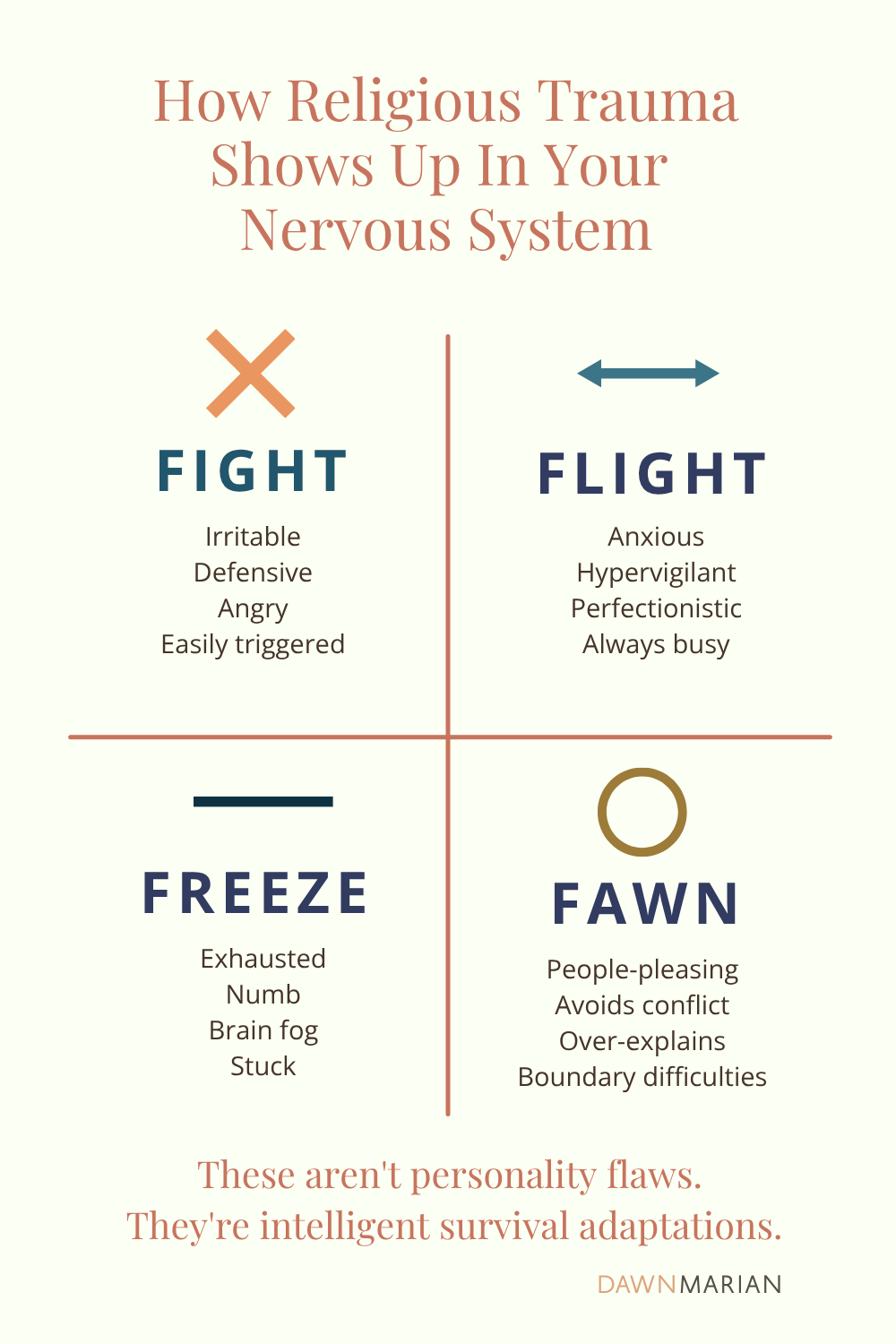
Most people don't stay in just one nervous system response. You may recognize yourself in several of them, moving between different survival strategies depending on the situation. These patterns are not signs that something is wrong with you. They are intelligent adaptations that once helped you survive.
Why it happens: Living under chronic fear, judgment, scrutiny or the threat of punishment teaches the nervous system that the world is not entirely safe. Even after leaving the religion, the body may continue responding as though the danger is still present.
6. Relationships feel confusing or unsafe
You struggle with boundaries, trust, conflict, intimacy, or belonging.
You may find yourself avoiding difficult conversations, fearing rejection, or feeling responsible for other people's emotions.
You may stay silent when something feels wrong or feel anxious when someone is upset with you. You may feel you have to work hard to earn love, approval, or acceptance.
For many survivors, relationships don't feel naturally safe. They feel conditional.
Growing up as one of Jehovah's Witnesses, I learned that love and belonging were conditional. You could lose your best friend overnight if they were kicked out for wrongdoing and it could happen to you too. Whether directly or indirectly, the message was loud and clear:
If you followed the rules, you remained part of the group.
If you didn't, there would be profound consequences.
While not every religious environment practices formal shunning, many high-control systems communicate a similar message: acceptance is earned through obedience, conformity, and loyalty.
Over time, those lessons can follow us into adulthood. We may fear abandonment, struggle with boundaries, hide parts of ourselves, or believe we must perform, achieve, or be useful in order to be loved.
One of the most important lessons in my own healing has been learning that healthy relationships don't require me to earn my place or constantly strive to be good enough to stay in the good graces of others.
I don't have to perform.
I don't have to agree.
I don't have to prove my worth.
I don't have to become someone else.
I can simply be myself and remain loved. I can have bad days and feel big emotions. I can feel small and scared and I can be my big, magnificent, creative and sometimes goofy self. The relationship can handle the spectrum of the experience.
For many people affected by religious trauma that realization isn't just a new idea.
It's a completely radical experience.
Why it happens: High-control systems often interfere with healthy attachment and teach conditional love. When belonging depends on compliance, it can become difficult to trust that relationships can survive honesty, boundaries, disagreement, or authenticity.
7. You Don't Trust Yourself
You may find it difficult to trust your own thoughts, feelings and instincts. Instead of listening to yourself, you second-guess your perceptions, dismiss your inner knowing or assume someone else must know better.
Maybe I'm overreacting.
Maybe I'm being selfish.
Maybe I'm reading too much into it.
Maybe I should get someone else’s opinion
Maybe I’m the problem
Who do I think I am, anyway?
You may ignore red flags, talk yourself out of your instincts, or seek endless validation before making decisions that you already know are right for you.
Why it happens: In toxic religious environments, truth is seen as external. Leaders, doctrine, scripture, or the organization are treated as more trustworthy than your own experience. Over time, many people learn to question their perceptions, dismiss their intuition, and override their inner wisdom. The voice of authority becomes louder than the voice within. If you've recognized yourself in several of these signs, you may be experiencing the lasting effects of religious trauma.
Understanding what happened is often the first step toward healing.
The Heart of It
-
Religious trauma isn't just about what you believed. It's about how those experiences shaped your relationship with yourself, others and the world around you.
-
The lasting effects of religious trauma are often intelligent adaptations that helped you survive.
-
Healing begins by meeting those patterns with curiosity and compassion instead of self-judgment. Instead of asking "What's wrong with me?" Try asking "What happened to me?"
If these signs resonate with you, you may be wondering how environments like this develop in the first place. In the next article, we'll explore what defines a high-control religion and the patterns that can make these groups so difficult to recognize from the inside.
Continue Your Journey
→ What Is a High-Control Religion?
If these signs felt familiar, you may be wondering, "How did this happen to me?"
Understanding the environment that shaped your experience is the next step in healing.