The Whole System Approach to Healing

You're on a healing journey. You go to therapy. You practice mindfulness. You learn about trauma. You try to speak to yourself kindly and affirm things like “I am worthy” and “I am enough”. (And you are!) You journal when you can fit it into your busy day.
You definitely feel different than you used to but…. despite all your efforts, all your issues never seem to fully go away.
Sound familiar? 🙋
You’re not alone.
✦ In this Article:
- Why healing can still feel incomplete, even after years of doing "all the right things"
- How our culture fragments healing into separate approaches and how that often mirrors the fragmentation created by trauma itself
- What it means to take a whole-system approach by bringing your body, mind, heart and spirit back into relationship with one another
- A new way of understanding healing as wholeness rather than the pursuit of becoming "healed"
The Great Search for the Missing Piece
Have you noticed? Every healing modality seems to have the answer.
You find one that resonates, dive in and it genuinely helps. You understand yourself in a new way. You heal. Life gets better.
Then, somewhere along the way, you hit an edge.
Another pattern surfaces. Another part of yourself asks for attention. Suddenly you're looking for the next answer.
Before long, you're moving from one modality to the next, hoping that this one will finally be the thing that puts all the pieces together.
It can be frustrating.
It gets expensive.
On a hard day or during a difficult life season, it's downright exhausting.
Full disclosure: I was a healing junkie for years. I was curious. I had lots of trauma. I love learning new things. So I dove into the healing world headfirst. And every modality I tried, studied and practiced helped me put together another piece of the puzzle.
The problem with healing isn't the modalities.
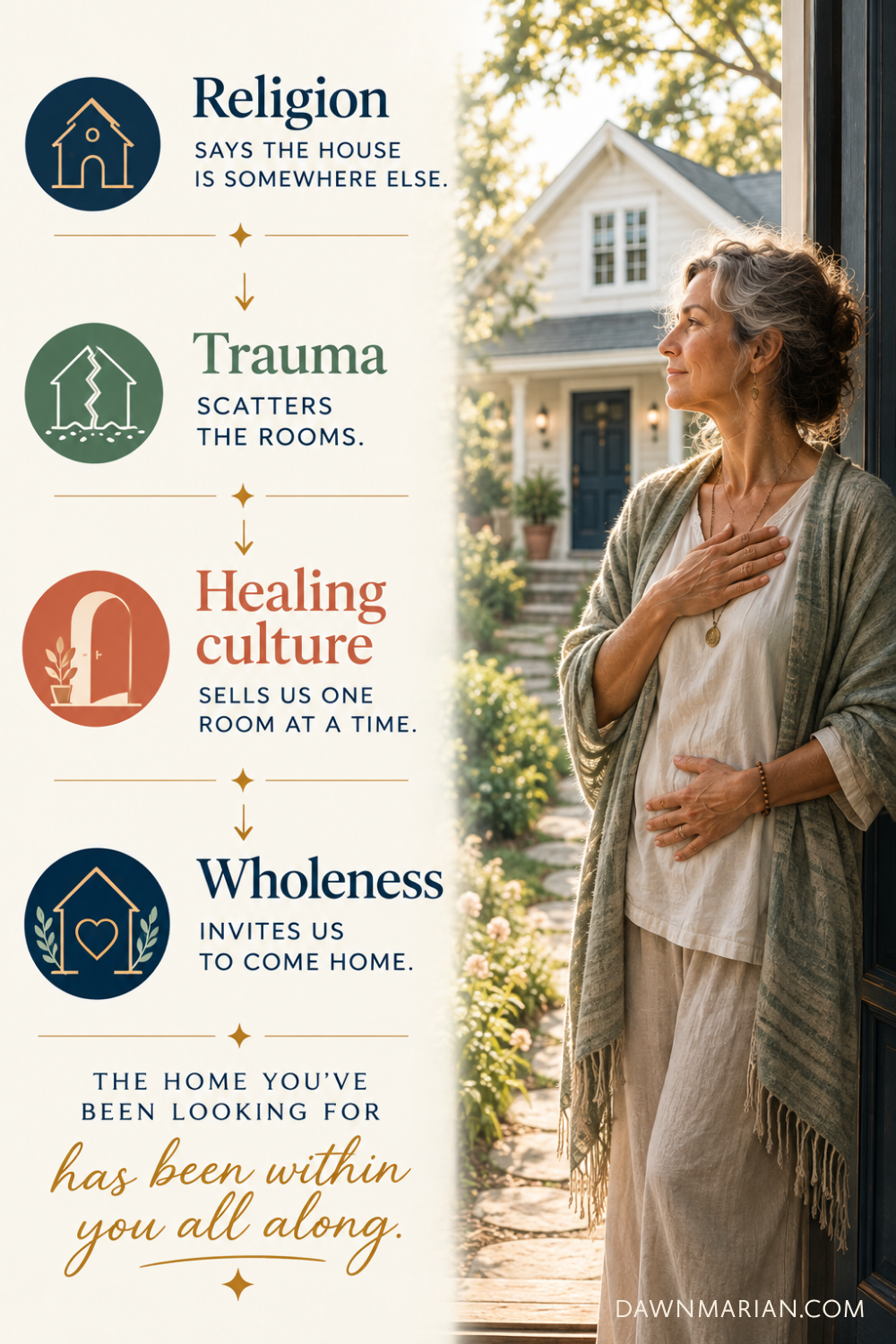
The problem is that modern healing culture can unconsciously reproduce the very worldview that created the wound: separation from ourselves.
What We Need to Understand About Healing: Three Layers Deep
If we're going to get off the healing hamster wheel, we first need to recognize the mechanism that sits under the healing and spirituality industry and how it works.
At its core, it's a pattern of fragmentation.
Layer One: Existential Fragmentation
This is the deepest layer that affects us collectively.
Many religious and spiritual systems teach that you are separate.
Separate from God.
Separate from truth.
Separate from your own authority.
Separate from your own capacity to know.
The message is that you’re incapable of repairing the separation on your own. The institution knows the way.
That, in itself, is a profound separation from your own connection with Source and your own wisdom. This pattern extends far beyond religion. It's woven into many of the systems that shape our lives, continually reinforcing separation from ourselves.
Layer Two: Psychological Fragmentation
Then trauma happens.
Trauma further separates us from ourselves. In an effort to self-protect, we fragment into pieces to safeguard ourselves. As a result we can become disconnected from our bodies, our emotions, and our inner knowing as different parts of ourselves adapt in order to survive.
The fragmentation now becomes internal.
Layer Three: Healing Fragmentation
Then we enter the healing world.
And instead of being invited back into wholeness...
we're often invited into another form of fragmentation.
"Regulate your nervous system."
"Adopt a miracle mindset!"
"Attachment theory."
"Psychedelics!"
"Shadow work."
“Spiritual awakening!"
In our desire for wholeness, we begin fragmenting the repair, healing piece by piece, and become frustrated and discouraged when the tools we invest our time, energy and money in don’t produce integrated or lasting results.
The Whole-System Approach
But what if healing isn't about finding the missing piece?
What if it's about remembering the whole?
What if every healing modality was simply a different doorway into the same house?
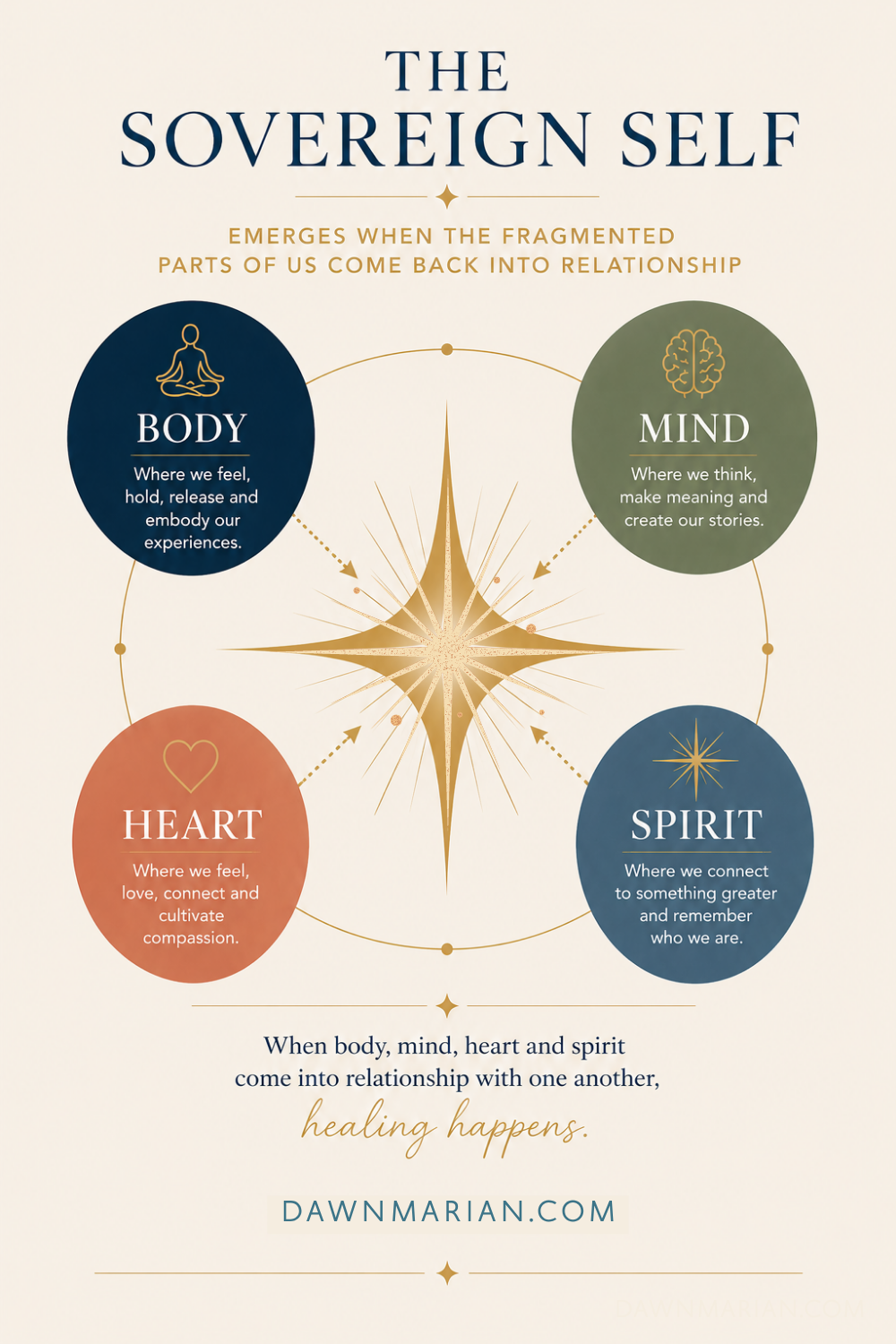
Therapy helps us understand our thoughts and experiences.
Somatic work helps us reconnect with the wisdom of the body.
Heart-centered practices help us cultivate compassion, connection and emotional healing.
Spiritual practices help us remember who we are beyond our conditioning.
Each doorway reveals something important.
But none of them were ever meant to be the entire house.
Why One Approach Only Gets Us So Far
This is why working in only one area eventually reaches a limit.
You may release trauma from the body and hit a wall when you realize you have no idea who you are without your past conditioning.
You may understand your dysfunctional childhood mentally while your nervous system still reacts as though it is happening today.
You may master higher spiritual planes of consciousness while your heart hasn’t fully developed and your ego is running the show.
You may work on forgiveness and cultivate gratitude, but you have an inner child who’s still sabotaging you every time you try to get bigger and be seen.
Here’s the rub: when our different parts are living in different realities, it becomes difficult to fully express ourselves, create the lives we want or move forward.
Profound healing that transforms your life from the core is about bringing every part of ourselves out of separation and into a relationship with each other.
This type of transformation leads to integration. What naturally emerges is what I call the sovereign self.
This is you that is connected to Source, to your wisdom, to your body and your spirit. It’s driven by your heart and served by your brilliant mind. It is aligned to your purpose, your passion and your joy. It is who you are here to be.
Healing Begins with Relationship
The first step in a whole-system approach to healing is to create a relationship with ourselves that's rooted in compassion.
The heart has the capacity to do that. It is relational in its nature.
It creates a container of acceptance that's spacious enough to welcome every part of ourselves home.
Instead of trying to fix ourselves, we begin by making it safe for every part of ourselves to be seen.
We stop trying to force change.
We stop blaming and shaming.
We stop fighting with ourselves and making ourselves wrong.
We throw perfection out the window.
We accept all the parts as they are: the ego, the small scared parts, the shut down parts and everything in between.We let the parts of us that are stronger and more developed sit alongside the parts that feel lost and disconnected and allow all of ourselves to belong.
We honor all of our parts for their experience and know they have something meaningful to contribute to our growth.
No part left behind.
Approaching Healing from the Whole System
Once we have created a container of compassion that can hold all of ourselves, we can get curious about the experience these parts have had and how they impact one another as a whole system.
With any given trauma or past experience we can ask:
How did this impact my nervous system? Where is my body still holding onto the memory?
What meaning or assumptions did my mind make about this? What story did I create to survive?
How did this impact my heart and my ability to relate to myself and others? What emotions are still present?
How did my spirit contract or limit itself as a result? What is my spirit yearning to do instead?
When the answers come, we listen.
Each perspective reveals another piece of the whole picture.
Healing becomes multi-layered, prismatic.
What Whole System Healing Looks Like in Real Time
The big idea is simple.
We learn how to create a space where our body, mind, spirit and heart can heal together.
We don’t attach to one method or modality as the answer.
We use our healing tools to match what our different parts need like a master craftsman.
We see triggers as information and adaptations as deep survival based wisdom.
The healing journey becomes deeply intertwined with presence and compassion.
The result? All of you, embodied. Whole.
✦ The Heart of It
The Whole-System Approach leaves no part of you behind.
Healing becomes about remembering your wholeness.
As your body, mind, heart and spirit come back into relationship with one another, you become more fully yourself.
More able to create.
More able to love.
More able to receive.
More able to trust yourself.
This isn't about becoming someone new.
It's about returning to who you've been all along.
Continue Your Journey 🠒
If you'd like support taking this kind of Whole-System Approach to your healing, I'd love to invite you to explore Root & Rise my small group journey for rebuilding after religious trauma from the inside out, or schedule a one-on-one session to begin working together.