3 Ways Religious Trauma Can Show Up in Your Body Long After You've Left

You left the religion.
You stopped believing the doctrine.
Your life is different and feels more like you and you’ve worked really hard to get there.
So why do you still get a terrible pit in your stomach and a flash of dread when you think you’ve done something wrong?
Or what about that background hum of low grade anxiety that never goes away even when everything seems to be OK?
Perhaps you struggle to relax even when you’re exhausted, perpetually second-guess your decisions or lay awake at night worried that you’re just not doing enough, being good enough.
I get it. I’ve been there. I spent decades constantly trying to become a better version of myself, healing my past and improving my life. And while so much of my life had changed, there were still things inside of me that seemed to stay stuck.
It wasn’t until I began to understand how years of religious conditioning had affected my body and nervous system that some of my struggles began to make sense. As I brought the body into my healing, my inner world began to reflect more of the freedom I had already created in my life.
✦ In This Article
-
Why religious trauma can continue to affect your nervous system long after you’ve left
-
How years of religious conditioning can affect the way your body responds to the world
-
Four common signs religious trauma may still be showing up in your body
How Does Religious Trauma Affect the Body?
So the big question is, “Okay...but how does religious trauma actually affect my body?”
After all, religion is something we believe. So why would it affect our muscles, our breathing, our digestion or our ability to relax?
The answer lies in the nervous system. Your nervous system has one primary job: to monitor your safety. It is constantly taking in information from inside and outside of you and asking, Am I safe?
In a high-control religious environment, safety and belonging are often conditional. You learn that there are certain things you need to believe, ways you need to behave and rules you need to follow in order to remain accepted. That can require an enormous amount of monitoring, both of yourself and of the people around you. You learn to watch for disapproval, censor yourself, shut down parts of yourself and continually assess whether you are in agreement with what is expected of you.
When your nervous system has to do that over and over again, your body begins adapting around the need to stay safe. Your muscles may remain chronically tense or develop patterns of holding that affect your posture. Your shoulders might stay lifted, your jaw clenched or your belly tight. Your breathing may become shallow, your digestion may be affected and your body may have difficulty fully settling into rest, even when there is no immediate danger.
None of these responses are conscious choices. They are intelligent adaptations to the environment you were living in. When your body practices those adaptations for years, they can become familiar patterns that continue long after you've left the religious environment that created them.
3 Signs Religious Trauma May Still Showing Up in Your Body
Once your nervous system has learned to organize itself around survival, those patterns don't simply disappear because your beliefs have changed. They become familiar ways of moving through the world.
You may not even recognize them as trauma adaptations because they feel like they have always been there and are part of your personality.
Here’s a visual overview of three ways religious trauma can continue to show up in the body, even long after you’ve left.
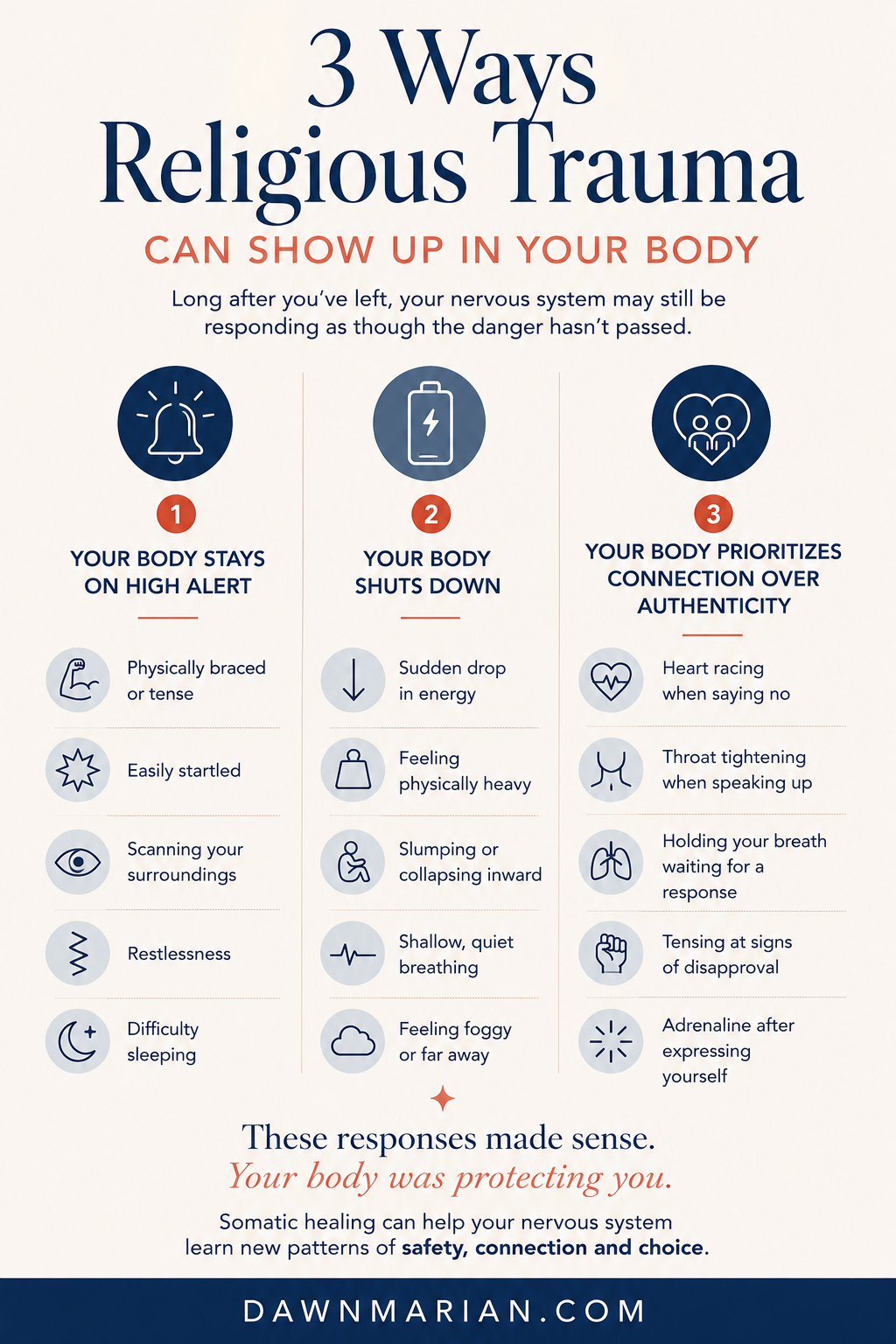
1. Your Body Stays on High Alert
One of the most common ways religious trauma can show up in the body is a persistent state of anxiety or hypervigilance. Even when life is relatively calm, your body may have difficulty believing that it's safe enough to fully relax.
You might notice yourself:
-
Feeling physically braced or tense even when nothing is wrong
-
Startling easily at unexpected noises, movement or someone entering the room
-
Constantly scanning your surroundings or tracking subtle changes in someone's voice, expression or mood
-
Feeling restless or having difficulty sitting still
-
Holding tension in your shoulders, jaw, chest or stomach
-
Having difficulty sleeping because your body doesn't fully settle
Or maybe it's harder to pinpoint. You just know, “I can never fully relax. Even when everything is fine, part of me is waiting for something bad to happen.”
When your body has spent years on alert, that state can become so familiar that you don't recognize it as hypervigilance. It can simply feel like the way you've always been.
2. Your Body Learns to Shut Down
Not everyone's nervous system responds to threat by staying on high alert. Sometimes the safest response is to shut down.
You might notice:
-
A sudden drop in energy or feeling physically heavy
-
Slumping, collapsing inward or wanting to curl up
-
Moving or speaking more slowly
-
Feeling physically numb or less aware of sensations in your body
-
Shallow, quiet breathing
-
Difficulty getting yourself to move or take action
-
Feeling foggy, spacey or far away
-
Zoning out during stressful conversations
This can make a lot of sense when you consider what it takes to live in an environment where certain feelings, questions, desires or parts of yourself aren't safe to express. When you can't fight or leave, your nervous system may learn that shutting down and disconnecting is one way to stay safe.
Over time, shutting down can become just as automatic as staying on high alert.
3. Your Body Prioritizes Connection Over Authenticity
For many survivors of religious trauma, your nervous system learned that preserving connection was safer than expressing yourself. Over time, you stop asking, What do I want? and start asking, What will keep everyone else happy?
That response can happen in your body before you've even had time to think about it.
You might notice:
-
Your stomach tightening when someone is upset or disappointed with you
-
Your heart racing when you need to say no, disagree or set a boundary
-
Your throat tightening or your voice getting quieter when you try to speak up
-
Smiling, laughing or nodding automatically when you're actually uncomfortable
-
Holding your breath while waiting to see how someone responds
-
Your body tensing at the slightest sign of disapproval
-
A rush of heat, shakiness or adrenaline after expressing what you really think
-
An immediate physical urge to smooth things over when there is tension
When your nervous system has spent years associating belonging with compliance, agreement and not going against the grain, expressing yourself can feel surprisingly vulnerable. Even simple acts like setting a boundary, stating a preference, disagreeing with someone or saying what you really think can create a very real response in the body.
There can be a vulnerability in letting yourself be seen when your body learned that being accepted depended, at least in part, on staying safely within what was expected of you.
Healing Begins by Helping Your Body Feel Safe Again
As you begin to understand the depth of how a high-control religion may have affected your body, it's normal to feel a little overwhelmed.
The good news is that your nervous system has been doing exactly what it was designed to do: protect you.
And because these patterns were learned through experience, they can also be gently reshaped through new experiences.
This doesn't happen overnight. It happens gradually, as you learn to listen to what your body is communicating and gently work with the patterns it developed to keep you safe. Rather than trying to think your way out of these responses, you can begin helping your nervous system experience new patterns of safety, connection and choice.
Body-based (somatic) practices can help you develop the skills to notice where you're holding tension, recognize survival responses as they're happening and stay present with sensations and emotions that may once have felt too overwhelming or unsafe to experience.
Over time, your body can begin to learn something new: I am safe now. I have choices now. I can listen to myself now.
✦ The Heart of It
-
Religious trauma doesn't just affect what you believe. Years of religious conditioning can teach your nervous system what to expect from the world.
-
The ways your body learned to protect you, whether by staying on high alert, shutting down or prioritizing connection, were adaptations to the environment you were living in.
-
Just as your nervous system learned these patterns through experience, it can gently learn new patterns of safety, connection and choice.
Continue Your Journey
If you'd like support learning how to create safety in your body and gently work with the survival patterns your nervous system developed, learn more about Embodied Processing.
→ Embodied Processing
If your body feels like it's always on high alert, learn more about hypervigilance, why it happens and how it can continue long after the danger has passed.
→ Understanding Hypervigilance After Religious Trauma
New to nervous system healing? Start here to understand how your nervous system works, why survival responses develop and what it means to begin working with your body as part of healing.
→ Nervous System 101