Nervous System 101: How We (Brilliantly) Survive Trauma

If you're like me, you probably didn't grow up thinking about your nervous system beyond what you memorized to pass a science test in middle school.
Most of us weren't taught how chronic stress affects the body, how to calm ourselves when we feel overwhelmed or how to safely process a painful experience. Without that understanding, it's easy to assume that something is wrong with you and that the solution is simply to try harder, relax more, have better boundaries or "just let it go."
Learning about your nervous system can give you insight into why you react the way you do, the patterns you find yourself repeating and what you need in order to fully recover from undigested life experiences.
Understanding Your Nervous System
Your nervous system is your body's communication network. It includes your brain, spinal cord and nerves, carrying messages between your brain and the rest of your body. It influences everything from movement and sensation to your emotions, stress responses and how your body responds to the world around you.
Your nervous system has one primary job: to keep you alive.
Every second of every day, it's scanning your environment, asking one simple question:
Am I safe?
When your nervous system feels safe, your body has more capacity to rest and restore itself. You can think clearly, connect with other people, learn new things, be creative and enjoy your life. Your body can also devote more energy to things like digestion, sleep, repair and recovery.
If your nervous system scans the environment and does not feel safe, it shifts into survival mode so it can protect you.
Sometimes the danger is immediate and obvious, like walking alone down a scary dark alleyway at night, being threatened or experiencing a car accident.
Our nervous systems also respond to emotional threats, including:
- Fear of rejection
- Fear of abandonment
- Fear of punishment
- Fear of not being loved
- Fear of making the wrong decision
- Fear of looking stupid or being laughed at
- Fear of disappointing someone
- Fear that something bad is going to happen
Your nervous system can also adapt to an unpredictable environment where you repeatedly feel unsafe, criticized, controlled, or unable to fully be yourself. This is particularly important when we're talking about experiences in childhood, because our nervous systems are developing while we're learning what is safe, what is dangerous and what we need to do to maintain connection with the people around us.
When we talk about healing from trauma, it isn't simply about focusing on a singular event that happened. It's also about understanding what happened inside of you as you lived through an experience or environment and whether your nervous system had the support and resources it needed to process it.
Body, Dismissed
Many of us learned to override what was happening inside our bodies at a young age.
Maybe you had to push through your fear and jump into the swimming pool before you were ready. Maybe you were taught that it wasn't okay to be angry or that "only girls cry." Perhaps you were told to look on the bright side instead of acknowledging that something hurt, to be seen and not heard or to think about other people before thinking about yourself.
These patterns can come from our families, our culture or our religion. They may have also been the best way we knew to survive difficult circumstances.
When we repeatedly override what we're feeling, our bodies aren't given the opportunity to process and move through stress. We stop communication with our body’s wisdom about what we need to bring ourselves back to a place of peace and calm.
Instead, pain gets postponed rather than processed. Grief gets buried instead of felt. Fear gets managed without addressing what's underneath it.
When something remains incomplete in our nervous system’s stress response, the original pattern can continue to show up in our everyday lives. Our nervous system is intelligent. It continues to bring our attention back to what hasn't been resolved, giving us another opportunity to listen and respond differently.
I think of these survival responses as the Big Four. Here's a quick look at how fight, flight, freeze and fawn can show up in everyday life.
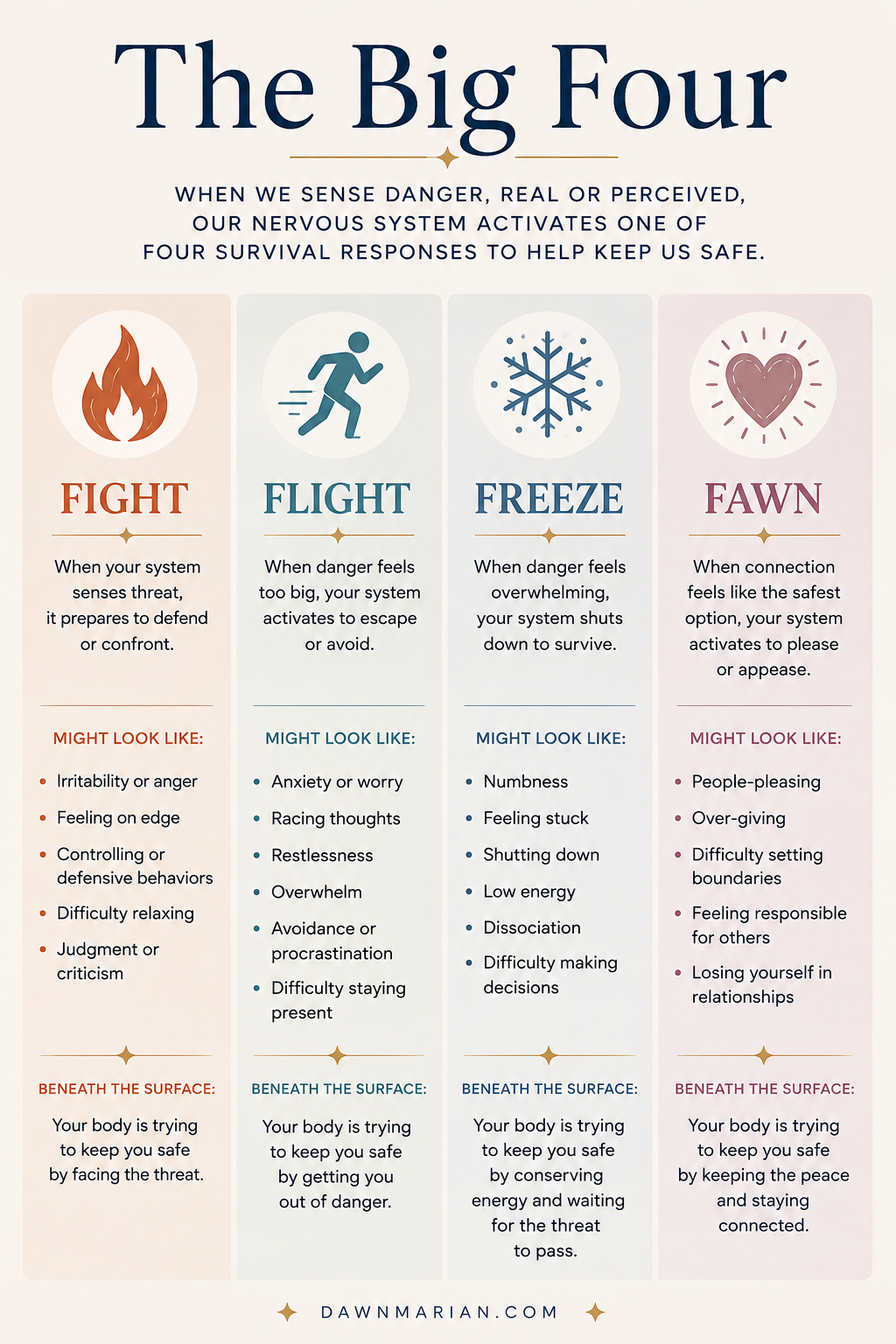
The Big Four: Fight, Flight, Freeze and Fawn
One of the most important things to understand about healing trauma is that your body is always trying to help you.
If your nervous system senses danger, it adapts and finds ways to protect you. These adaptations are known as fight, flight, freeze and fawn, and they're quite brilliant responses. They're designed to give your body the best chance of surviving something that feels threatening or unsafe.
Sometimes, however, the nervous system isn't able to fully complete the stress response cycle and return to a sense of safety. The response that helped protect you in the past can then continue to be activated in your everyday life, even when you're no longer in the same danger.
You may find yourself being triggered or reacting in ways that don't seem to make sense in the present because your nervous system is responding to something it learned to protect you from in the past.
Fight: "Something in me is pushing back."
Fight is exactly what it sounds like. It gives your body the energy to protect and defend yourself. If someone were hurting you or someone you loved, that surge of energy that helps you push back, yell, defend yourself or take action is incredibly useful.
When a nervous system gets stuck in the fight response, however, that same protective energy can begin showing up as irritability, feeling constantly on edge, losing your patience more easily than you'd like, becoming defensive or carrying a quiet rage that never seems to go away.
Sometimes being stuck in fight mode is described as having a "chip on your shoulder," having a "short fuse" or blowing up over little things.
It's important to understand that anger itself isn't a problem. Anger is a healthy emotion that can help us recognize when something isn't right, when a boundary has been crossed or when we need to protect ourselves. When anger is allowed to be felt, understood and moved through us in a healthy way, it can give us important information and help us to stay safe.
The challenge is when the nervous system continues responding as though it needs to fight even when the original threat is no longer present.
Flight: "I need to get away."
Flight is the nervous system's response to flee a threatening situation and move toward safety. Sometimes we can physically get away from danger by running away or leaving the situation. But when the threat is part of an ongoing environment, physically leaving may not be possible.
When we can't physically leave, the nervous system can find other ways to escape by mentally or emotionally checking out. On the more extreme end, this can look like dissociation and feeling disconnected from yourself or what's happening around you.
Flight can also show up as constantly daydreaming or disappearing into books, reality TV, soap operas, video games or other imaginary worlds. Someone chronically stuck in flight might be described as "spacey," "having their head in the clouds" or "not quite all there."
For others, flight looks like constantly staying busy. Always working, doing or moving can be a way of trying to outrun uncomfortable feelings that may surface when not in constant motion. This can look like always being "on the go," becoming a workaholic or being described as someone who is "constantly on the go."
When the nervous system is continually trying to escape even when the original threat is no longer present, it needs an opportunity to come out of flight, return to the present moment and re-establish a sense of safety.
Freeze: "I just shut down."
When the nervous system doesn't believe it can fight or get away, it has another option: freeze. Think of a possum playing dead when it feels threatened. The body shuts down, conserving energy and protecting itself until the danger has passed.
Freeze is an important survival response. When the nervous system becomes overwhelmed and there doesn't seem to be another way out, shutting down can be a form of self-preservation.
However, when a nervous system is chronically stuck in freeze, someone may feel numb, disconnected from life or from the people they love, or like they're just going through the motions. There may be very little access to emotions or desires, and a sense of apathy can begin to set in: "What's the point?"
Freeze can also make it difficult to get things done or move forward in life. It may show up as procrastination, inability to make decisions, difficulty starting things you know you need to do, and letting tasks pile up. It can also show up as feeling foggy, difficulty concentrating or losing track of time.
When we're stuck in freeze, the nervous system needs an opportunity to come online, recognize that the danger has passed and begin to experience that it's safe to engage with life once again.
Fawn: "If I can keep everyone happy, maybe I'll be safe."
Fawn is another way the nervous system tries to create safety when fighting, fleeing or shutting down doesn't feel like an option. Instead, you try to make yourself useful, valuable or agreeable to the person or people around you who feel threatening or unsafe.
Think about deciding to become friends with the mean girl at school because if she likes you, maybe she won't pick on you. Fawning works in a similar way. By keeping the people around you comfortable and happy, you may be able to avoid becoming the target.
Fawning can be particularly difficult to recognize because our culture often rewards the behaviors associated with it. Being helpful, dependable, agreeable, always saying yes, avoiding conflict and putting other people's needs first can all be seen as positive qualities. Someone who fawns may be known as "low maintenance," “the good girl”, “a people pleaser”, or be the person everyone knows they can count on.
None of those qualities are inherently unhealthy. But when keeping other people happy becomes a strategy for maintaining safety, fawning can begin to feel like a role you have to play. You become so attuned to what everyone else needs, wants or feels that you lose touch with your own needs, desires and boundaries.
Living this way can be exhausting and can eventually lead to burnout. The nervous system constantly monitors the people around you and adjusts your behavior to maintain connection and safety, often at your own expense.
When the nervous system is chronically stuck in fawn, it hasn't yet learned that the danger has passed and that it's safe to stop playing the role. Over time, the adaptation can become so familiar that it begins to feel like part of your identity rather than something your nervous system learned to do to protect you.
When Survival Responses Start to Feel Like Your Personality
When you've been living with a nervous system response for years, it's easy to think it's simply a part of who you are.
You might say things like, "I'm just an angry person," "I've always been a workaholic," "I'm a procrastinator," "I'm just really easygoing," "I've always been a people pleaser" or "I've always been kind of spacey."
But some of the qualities we think of as personality traits may actually be nervous system adaptations that developed in response to our environment.
That doesn't mean everything about your personality is a trauma response. It simply gives you another lens through which to understand yourself and become curious about the patterns you've carried for a long time.
Part of deepening your healing journey is beginning to ask: Is this actually who I am, or is this something I learned to do to feel safe?
And then there is a second, very important question: How can I create a greater sense of safety in my body right now, so these unresolved stress responses have an opportunity to move toward completion?
Understanding Your Nervous System Is Part of Healing
You may recognize yourself in one of these responses or see yourself in all four. Your nervous system doesn't choose one response and stay there. You might spend much of your life in fight or flight, then move into freeze when you become overwhelmed. You might fawn in certain relationships while responding with fight in others. Your nervous system uses different strategies depending on what it believes will keep you safest in that moment.
If you're just beginning to understand your nervous system, recognizing these patterns can feel overwhelming. It can seem like you've suddenly discovered one more layer of yourself that needs to be healed.
But these adaptations aren't weaknesses, and they're not evidence that something is wrong with you. They're intelligent ways your nervous system learned to protect you. Understanding them isn't about finding more things to fix. It's an invitation to become more compassionate and curious about yourself and what your body has lived through.
When we're healing from trauma, we often focus on what happened and how we feel about it. We might talk about our experiences, understand them intellectually, identify the beliefs and patterns that developed from them and work with the emotions connected to what happened.
All of this is an important part of the healing journey, but there's also a nervous system layer to healing. Your body lived through your experience too.
Deepening your awareness and appreciation of your nervous system, including all of the brilliant ways it has learned to protect you, can begin to change the way you relate to your experiences and to yourself. Instead of seeing your responses as something that's wrong with you, you can begin to understand what your body has been trying to do for you.
Recognizing that you're in fight, flight, freeze or fawn is an important beginning, but awareness alone doesn't necessarily show your nervous system the way back to safety. If your body has spent years living in survival mode, safety itself may feel unfamiliar.
Part of healing is gently reintroducing your body to a sense of safety and developing tools that help your nervous system recognize that the danger has passed. Over time, unresolved stress responses have an opportunity to move toward completion, allowing the nervous system to come out of survival mode.
This isn't about forcing your body to relax. It's about becoming more in tune with the information and wisdom your body holds while gently helping it experience something it may not have experienced in a very long time, or ever: safety.
This is one reason healing trauma is so multilayered. We aren't only working with our thoughts, beliefs or emotions. We're also helping the body process and integrate what it has lived through.
✦ The Heart of It
Your nervous system is an important part of who you are. It's a brilliant protector, and it can also become a powerful ally in your healing. Fight, flight, freeze and fawn are intelligent responses your body developed to help you survive experiences and environments that felt threatening or unsafe.
Healing your nervous system means helping it recognize that the danger has passed, complete what may still be unresolved and return to a sense of safety.
The more you understand your nervous system, the more you can begin to appreciate the ways your body has worked to protect you. You can listen to it, learn its language and gently help it remember that it doesn't have to stay stuck in survival mode forever.
Your body has been trying to protect you all along. Now you can begin helping it feel safe.
Continue Your Journey
If you'd like support creating greater safety in your body and working with the nervous system patterns you've begun to recognize, Embodied Processing offers a gentle, body-based approach to working with emotions, survival responses and unresolved experiences.
→ Consider Embodied Processing
If you're already on the path of nervous system healing and would like another tool to support your body, Reiki can be a gentle addition to the work you're already doing.
→ Explore Reiki for Nervous System Healing