The Four Stages of Healing from Religious Trauma

Healing often unfolds in recognizable stages.
This article is written for people who have left a high-control religion. If you’re still inside a high-control system and questioning your experience, I hope it offers a glimpse of what healing can look like if and when you choose that path.
Recovery isn’t about how long you’ve been out. It’s about recovering the parts of yourself you had to give away to survive within a high-control religious group.
Whether you left six months ago or twenty years ago, you may recognize yourself somewhere in these stages. Think of these stages as a map to help you understand where you are, what your next step may be and where you’re headed.
In This Article
✦ The four stages of healing from religious trauma
✦ What each stage of recovery often looks and feels like
✦ The challenges and opportunities that arise along the way
✦ Why recovery is about so much more than leaving a high-control environment.
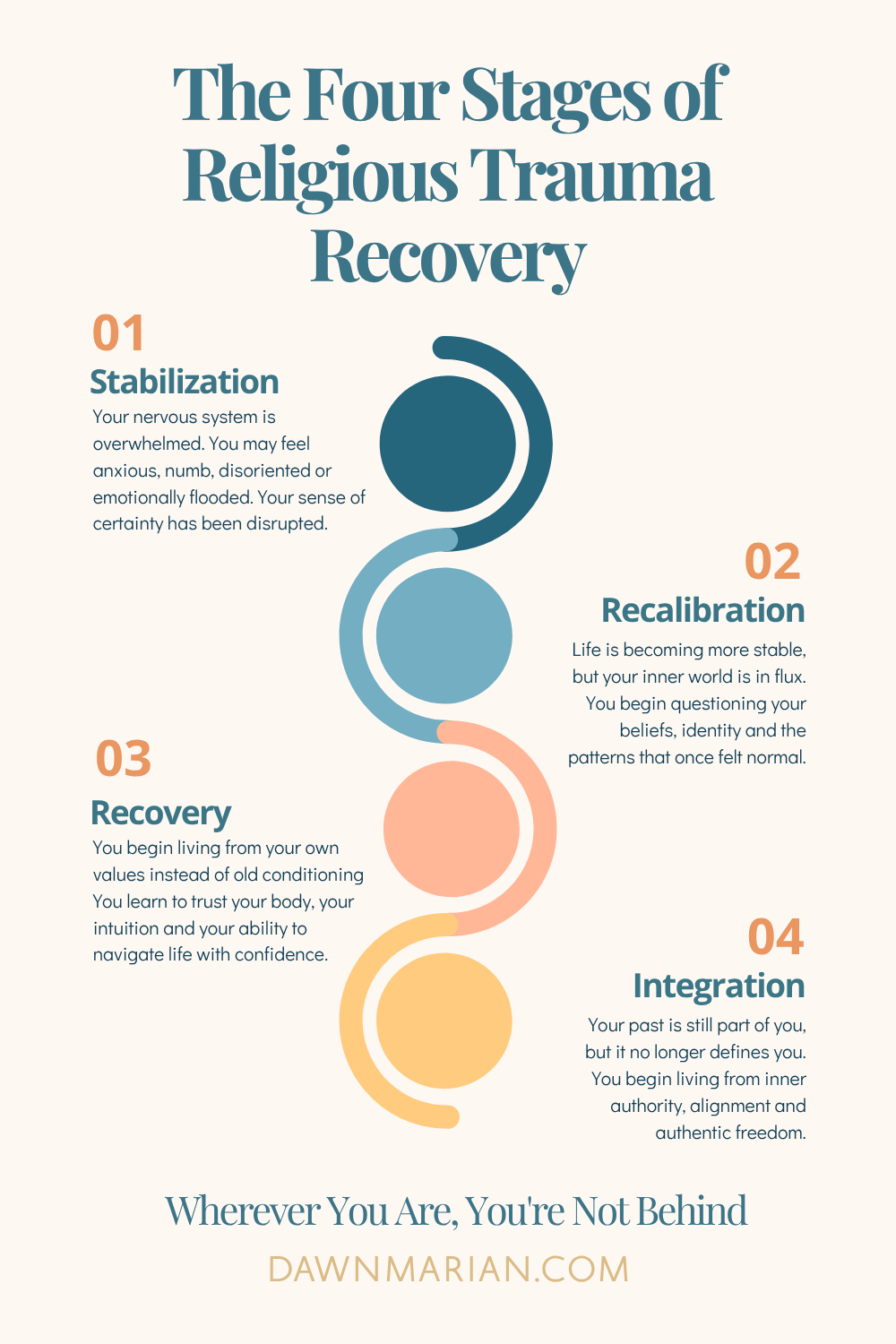
Healing isn't one single event. It unfolds over time, and each stage has its own challenges, questions and developmental tasks. This framework offers a broad overview of what that journey often looks like.
Stage 1: Stabilization
Every religious trauma recovery journey begins with some kind of rupture.
You may have been disfellowshipped, excommunicated, shunned or pushed out.
You may have quietly drifted away after years of questioning.
You may have reached a point where you realized the beliefs no longer aligned with your values and made the painful decision to leave.
You may have had to escape.
However it happened, the life you knew was gone.
Leaving a high-control religion isn't just a change in beliefs. It's a profound transition that touches every area of your life.
What comes next looks different for everyone. You may lose family, community and lifelong friendships. You may need to rebuild a career, find a new place to live or learn how to navigate a world you've been taught to fear. You may leave with a strong support system intact, or you may leave completely alone.
Every story is different, but the work of this stage is the same:
To survive the fracture by creating enough safety and stability so that healing becomes possible.
Creating the First Anchor Points
At this stage, life often comes down to the basics.
Where will I live?
How will I support myself?
Who can I trust?
How do I get through today?
This is why I think of Stage One as Stabilization.
It's about creating new anchor points for life.
A safe place to live.
A job.
Financial stability.
Supportive relationships.
Daily routines.
A sense that tomorrow is both repeatable and manageable.
When I left Jehovah's Witnesses, I had to start my life from scratch. Life as I had always known disappeared overnight. I found a new apartment because I had been living with another Jehovah's Witness. I started working full-time at a restaurant. My non-JW father gave me an older car to drive. I made a few new friends at work (some of whom are still in my life more than thirty years later).
All of these things helped me to create a base for my new life.
Your Mental Health Needs Extra Support
Your mental health is often at its most vulnerable when you are stabilizing in your new environment.
Your nervous system is also working overtime. It is trying to adapt to a profound loss of safety while remaining on high alert for new threats. This can leave you feeling overwhelmed, physically exhausted and unable to think clearly.
You are most likely carrying an enormous emotional load. Shock. Grief. Shame. Fear. Confusion. Anger. You may feel depressed, anxious and lost.
It's natural to look for ways to cope with the overwhelming emotions.
For some people, that may look like alcohol, drugs or sex. For others, it may be throwing yourself into work, exercise or a new relationship. It could also look like binge watching/ gaming, shopping, gambling, or being constantly busy. It's important to remember that all coping behaviors have one thing in common: the desire to feel better and temporarily reduce the emotional weight.
Finding a therapist or mental health practitioner to support you can make an enormous difference. If possible, look for someone who understands coercive control or religious trauma. If those specialists aren't available, finding someone who listens well, respects your autonomy and with whom you feel safe with is more important than finding someone with the perfect credentials.
At this stage, the goal isn't to process every part of your trauma. It's to have someone who can help you feel seen, supported and less alone as you begin rebuilding your life.
Heightened Vulnerability
This is also a time of heightened vulnerability.
When you've spent years relying on an external authority to tell you what is true, who you should be and how you should live, you've had limited opportunity to develop and trust your own inner guidance. As a result, it can be harder to recognize unhealthy dynamics when they appear again.
After leaving one high-control environment, it's easy to underestimate how vulnerable you may be to another. That might be another religious group, a controlling relationship or a charismatic leader.
As you continue on your healing journey, you'll develop and strenghten one of the most important skills in recovery: learning to trust yourself. With time and experience, your ability to recognize healthy and unhealthy people, relationships and situations becomes stronger.
Whenever possible, give yourself permission not to make any major commitments while you're finding your footing. The goal isn't to have what’s next figured out in this phase. It's to create enough safety, stability and support so that healing can begin.
Explore: Embodied Processing Session →
Stage Two: Recalibration
Once your life begins to stabilize, your energy naturally shifts from surviving to living, and you begin reorienting to yourself and your new life.
Who Am I Now?
Without the structure of the high-control system dictating who you should be and what you should think, new questions begin to emerge.
Who am I now?
What do I believe?
How do I want to live?
What feels true for me?
A new adventure begins. You may find yourself drawn toward interests you weren't able to fully develop or passions you had to set aside or hide to remain part of the group.
You may reconnect with people you'd lost contact with or build new friendships. You might try different social settings, wear clothes you never would have worn before, listen to different music or change the way you speak as you experiment with new ways of being in the world.
You may also become curious about spiritual beliefs and practices that were once off-limits. You might investigate other religions or philosophies, explore spirituality outside organized religion or experiment with mindfulness and other contemplative practices.
This part of the journey can be equal parts exciting and terrifying.
For the first time, you have the freedom to choose your own path. At the same time, the rigid structures that once told you exactly what to think and do are no longer there. The freedom to be who you are and who you want to be can feel exhilarating. It can also feel like free fall.
When I was figuring out who I was, I enrolled in college. I studied new languages, became a feminist and read tons of books. I made art. I moved to Italy. I practiced Buddhism for six months. I dated all kinds of different people. Every experience helped me get to know myself more deeply: my preferences, what made me happy and what wasn't for me.
If this is where you're at, have patience with the process. Getting to know yourself is a lifelong endeavor. You will always be discovering different parts of yourself and each experience teaches you something new about who you are.
The Highs and the Lows of Recalibration
As you are recalibrating to your new world, your emotional landscape can shift quickly.
One minute, you may love your life. You're free! You can do and be anything you want.
The next minute, you may be hit by a wave of grief or anger.
You may lie awake at night and wonder:
What's happened to the people I left behind?
Will this ever stop hurting?
Will I ever recover?
This period can also be accompanied by a profound loneliness. It can feel nearly impossible to articulate your experience when you're still trying to understand it yourself, especially to someone who has no understanding of where you've come from or what you've been through.
Working with a trauma-informed therapist can be an invaluable support as you navigate the grief, anger and loss that often accompany this stage. Depending on your needs, approaches such as Eye Movement Desensitization and Reprocessing (EMDR), Accelerated Resolution Therapy (ART), Internal Family Systems (IFS), Emotional Freedom Technique (EFT, also known as tapping), somatic therapy or Embodied Processing may help you safely process traumatic experiences, regulate your nervous system and reconnect with yourself.
What Happened to Me?
You're building a new life, but you're also trying to understand what happened to you.
You may begin questioning yourself, the beliefs you once held, the organization you trusted and your understanding of what happened.
Why did I stay so long?
If I don't believe that anymore, what do I believe now?
What was real, and what wasn't?
This questioning can feel unsettling, but it's also a natural part of healing. As humans, we're wired to create coherent stories. We need our experiences to make sense. When they don't, we naturally keep turning them over, looking for the missing pieces that will help us understand what happened.
For me, those questions centered around the Jehovah's Witnesses.
Who were they, really?
Were they telling the truth? What if I was wrong?
How could people I had shared my entire life with suddenly act as though I no longer existed?
Was my whole life built on a lie?
People begin making sense of their experience in different ways. Some work with a trauma-informed therapist. Others find support in communities of people recovering from religious trauma. Reading other survivors' experiences can also be incredibly validating.
For me, making sense of what happened began with sculpture.
Long before I had the capacity to process the trauma, I was making art. My work was raw, honest and messy, but it gave voice to what I couldn't yet put into words. In many ways, art was my first healer.
If this is where you are, education can be an invaluable companion. Learning about religious trauma, high-control groups and coercive control can give you language for your experience and help you make sense of where you've been.
Understanding what happened is an important part of healing from religious trauma. But eventually, many people discover that understanding their story isn't the same as healing from it. That realization often becomes the doorway into the next stage of the journey.
Explore: Reiki for Nervous System Regulation→
Stage Three: Recovery
There comes a point when you realize that just because you're out doesn't mean you're completely free.
You've built a new life. You're a different person. From the outside, it may even look like you've completely moved on.
But on the inside, something still doesn't feel quite right.
You begin noticing that old programs are still running quietly beneath the surface. It might show up as a persistent feeling that you're somehow wrong or not good enough. Second-guessing yourself and deferring to authority instead of trusting your own judgment. Feeling afraid to set boundaries or say no. Overgiving, people-pleasing or feeling like you have to earn your worth. Living with a quiet, low-grade anxiety that never seems to fully go away, even when life is objectively safe.
This is often the moment you realize the work is no longer rebuilding your life. It's rebuilding your relationship with yourself.
It requires gently untangling the conditioning, survival strategies and protective patterns that once helped you stay safe but now keep you from fully living.
If you were born into a high-control religion, this work often runs even deeper. The conditioning began from the very beginning of your life, becoming the lens through which you related to yourself, other people and the world around you. Dismantling that early imprinting takes time.
Rebuild Yourself from the Inside Out
This is where your healing journey begins to shift.
Rather than focusing on understanding your past, you begin to intentionally build a different relationship with yourself in the present.
Recovery isn't about becoming someone new.
It's about recovering the parts of yourself you had to sacrifice in order to stay safe within a high-control system while strengthening the parts of yourself that never had the opportunity to fully develop.
You learn to meet yourself with curiosity instead of criticism.
You begin listening to your heart instead of your conditioning.
You cultivate self-trust instead of looking outside yourself for answers.
You reclaim your:
- voice
- intuition
- wisdom
- agency
As you step into your own personal power, your relationship with yourself begins to change. You begin to see yourself through the lens of courage and resilience instead of your perceived deficiencies. Your inner world is no longer organized around fear and external authority, but around your sovereignty and inner guidance.
If early recovery is the stage you are in, it is often the season for deeper healing work. Not just learning about healing from religious trauma, but living it. Day by day, you create a life that reflects who you are becoming rather than the conditioning you left behind.
Explore: Root & Rise Group Coaching→
Stage Four: Integration
Integration is where all the work you've done to recover yourself becomes embodied.
The conditioning of your past is no longer running your present.
It doesn't mean you're completely healed. It doesn't mean you never get triggered or that life becomes effortless.
It means you recognize what's happening when old patterns arise, and you have the awareness, tools and ability to bring yourself back to your center.
You have the capacity to hold all of yourself with greater compassion. Rather than judging or rejecting the parts of yourself that still carry pain, you learn to listen to them with love. You know how to regulate your nervous system, move through difficult emotions and find your way back to yourself.
As you continue to grow, you begin to reconcile your past.
You accept your journey for what it has been.
The experiences are still part of your story, but they no longer define who you are.
You are no longer living in reaction to your past. You're living from the person you've become.
You are present with your body, your heart, your mind and your spirit.
Your life is no longer organized around the external world, but around your center.
You live from your own alignment, guided by your own values, intuition and wisdom.
You trust yourself.
Every part of you belongs to you.
What Comes Next?
As more of the conditioning falls away, more of who you truly are becomes available to you.
The energy that once went toward recovery is now available for something else. There is more space to fully express who you are.
For some people, that means pursuing a lifelong dream or finally saying yes to something that has been quietly calling to them for years.
Some people find purpose in their experience and feel inspired to help others navigate religious trauma. They may write, teach, create, advocate, build community or step into professions dedicated to healing and supporting others.
For many, it simply looks like fully inhabiting their own life. Laughing more. Loving more deeply. Being present. Having the freedom to choose what matters most and living authentically.
There is no right way for integration to look.
What matters is that your life is no longer shaped by conditioning, but by the deepest, truest parts of who you are.
Explore: CORE Mentorship→
Wherever You Are, You're Not Behind
Now that you've seen this map of healing from religious trauma, you may have a better sense of where you are on your own journey. You may even recognize yourself in more than one stage at once.
Healing isn't a race, and recovery isn't a destination.
As life unfolds, you may find yourself revisiting an earlier stage after a difficult experience or major life transition. That doesn't mean you've gone backward. Healing is often circular, and each time you return, you bring more wisdom, more compassion and more capacity than you had before.
The goal isn't to never struggle again.
The goal is to return to yourself more quickly, more gently and more completely each time.
The Heart of It
✦ Healing from religious trauma is about reclaiming the parts of yourself that were hidden, silenced or never fully developed within a high-control system.
✦ Recovery isn't about moving through these stages perfectly. It's about meeting yourself with increasing awareness, compassion and self-trust wherever you are.
✦ There is no "right" place to be. Every stage has its own purpose, and every step is part of coming home to yourself.