What Leaving Jehovah's Witnesses Does to Your Nervous System

Leaving Jehovah's Witnesses can be one of the most traumatic life events a person can experience.
You aren't just leaving a religion. You're leaving behind your community, your support system and your identity. You're exchanging everything you've been conditioned to believe was safe, right and true for a world you've been taught to fear and distrust. And if you were disfellowshipped, most likely your world has just blown up.
If you’ve been there, my heart goes out to you. 💔
But, let's fast forward a few years. You have a new life, new friends, and new routines.You most likely no longer believe the teachings, and you finally have the freedom to be yourself.
So why does your body feel like it's constantly on edge and waiting for something bad to happen?
✦ In This Article
- Why leaving Jehovah's Witnesses is a nervous system event, not just a life change
- How high-control environments shape the nervous system over time
- The difference between developmental trauma and acute trauma
- Four common nervous system adaptations after leaving the organization
- Why these adaptations are signs of survival, not personal failure
- Simple ways to begin rebuilding safety and connection with your body
You Were Taught Not to Trust Your Body
As a Jehovah's Witness, you're taught that your heart is treacherous. Your desires can't be trusted. Your body can lead you into sin. Remember the story of David and Bathsheba?
That conditioning extends beyond doctrine. It shows up in rules around dress and grooming, sexuality and the constant admonition to remain vigilant against the desires of the flesh.
Over time, this creates a profound separation between you and your body. Your body becomes something to fear and mistrust rather than something to listen to.
Your nervous system communicates through your body. When you're taught to disconnect from your body, you also become disconnected from your nervous system's cues. You become less able to notice what your body needs, respond to the signals it's sending or complete the stress responses it was designed to move through.
Understanding Your Very Important Nervous System
If you've never learned about the nervous system before, you're not alone. I certainly hadn't until I began studying somatic healing. And because Jehovah's Witnesses are often discouraged from exploring psychology, trauma and many therapeutic approaches, this way of understanding yourself may be completely new.
Your nervous system is your body's built-in survival system. Its job isn't to decide what's real or false, right or wrong. Its job is to keep you alive.
It constantly takes in information from your surroundings, looking for signs of safety or danger, and automatically adjusts your body to help you respond. When it senses safety, you can rest, connect with others, think clearly and engage with the present moment. When it senses danger, it shifts into survival responses designed to protect you.
This is why understanding the nervous system is so important when we talk about trauma. Trauma isn't just about what happened to you. It's also about how your nervous system adapted to what happened. Those adaptations are intelligent. They're your body's way of helping you survive an environment that felt unsafe, unpredictable or overwhelming.
It learns from experience. When an environment feels threatening or unstable, your nervous system adapts to help you survive. Those adaptations are automatic and can continue long after the environment has changed.
For former Jehovah's Witnesses, understanding the nervous system can offer an entirely new way of making sense of your experience. Many nervous system adaptations that have felt limiting or frustrating aren't character flaws or signs that you're broken. They're survival adaptations that once helped you navigate life inside the organization.
Your Nervous System Learned to Survive Inside the System
For many former Jehovah's Witnesses, trauma doesn't begin when you leave.
- disconnect from your body and your own inner wisdom
- silence yourself
- monitor yourself for wrongdoing
- constantly strive to be perfect
- always be ready for Armageddon
- be prepared for persecution
- defer to the authority of the elders and the Governing Body
Living for years in an environment where your safety, your belonging and even your survival depend on obedience impacts the way your nervous system develops. Over time, the nervous system adapts to whatever environment it is repeatedly exposed to. When that environment is chronically unsafe, controlling or unpredictable, those adaptations can become part of developmental trauma.
Rather than being caused by a single traumatic event, developmental trauma happens over time when important developmental needs for safety consistently go unmet. It changes how you experience yourself, other people and the world around you.
Many former Jehovah's Witnesses also carry acute trauma as part of their experience. Unlike developmental trauma, acute trauma occurs when the nervous system is overwhelmed by a specific event or series of events, such as being disfellowshipped, experiencing abuse that wasn't taken seriously by the elders or being denied a medically necessary procedure or mental health treatment because of the organization's stand on medicine.
Those experiences are deeply traumatic on their own. But they often occur on top of a nervous system that has already spent years adapting to survive life inside the organization.
Trauma and the Nervous System
It's also important to understand that trauma can take different forms.
When most people think about trauma, they think of acute trauma. Acute trauma is what happens when the nervous system is overwhelmed by a specific event or series of events. For former Jehovah's Witnesses, this might include being publicly reproved, experiencing harm within the congregation that wasn't taken seriously by the elders or being denied a medically necessary procedure or mental health treatment because of the organization's teachings.
But there's another form of trauma that is especially relevant for many people who were raised as Jehovah's Witnesses: developmental trauma.
Rather than being caused by a single event, developmental trauma happens over time when important emotional and developmental needs consistently go unmet during childhood and adolescence. Needs such as safety, secure attachment, emotional attunement, the freedom to express yourself, autonomy and the ability to develop your own identity are all essential for healthy development. When those needs are repeatedly interrupted or sacrificed in order to survive within a high-control environment, the nervous system adapts.
For those who joined Jehovah's Witnesses later in life, the experience may look different. While it may not meet the definition of developmental trauma, living for years within a high-control environment can still result in profound relational trauma, attachment trauma and complex trauma as the nervous system adapts to chronic stress, fear and coercive control.
Just as the nervous system adapts to acute trauma, it also adapts to developmental trauma. Those adaptations aren't a sign that something is wrong with you. They're intelligent survival responses that helped you navigate the environment you were living in.
Many former Jehovah's Witnesses carry both acute and developmental trauma. Their nervous system spent years adapting to the chronic stress of life inside the organization. Then, when they left, many experienced an acute rupture through the loss of family, community, identity and everything they had been taught was safe and true.
Understanding both forms of trauma helps explain why leaving the organization can feel so overwhelming, and why the effects can continue long after you've built a new life.
What Happens to Your Nervous System When You Leave Jehovah's Witnesses?
Everyone's experience of leaving Jehovah's Witnesses is different, and every exit places different demands on the nervous system.
For those who were briefly associated with Jehovah's Witnesses, joined as adults, left of their own volition and/or were never baptized, and most importantly, if they had a healthy support system outside the organization, the nervous system may gradually begin to regulate after they leave.
For those who were born into Jehovah's Witnesses, and especially those who were disfellowshipped and severed from their families and communities, leaving can be one of the most overwhelming and stressful experiences the nervous system can endure.
Shock, grief, shame, fear and anger can all hit at once. At the same time, you're experiencing the loss of your identity, your routines, your loved ones, your community and the entire life you once knew.
The nervous system activates and moves into survival mode because that is exactly what it is designed to do: survive.
For many former Jehovah's Witnesses, this acute rupture doesn't happen in isolation. It occurs on top of years of developmental trauma or other forms of chronic relational and complex trauma. The nervous system is carrying both the long-term adaptations that developed inside the organization and the acute trauma of leaving it.
This is exactly how a healthy nervous system responds to overwhelming threat. The difficulty arises when those survival adaptations continue long after the danger has passed. Even after you've built a new life, your nervous system may still respond as though the threat is still present.
Here's a visual overview of four common nervous system adaptations many former Jehovah's Witnesses experience. We'll explore each one in more detail below.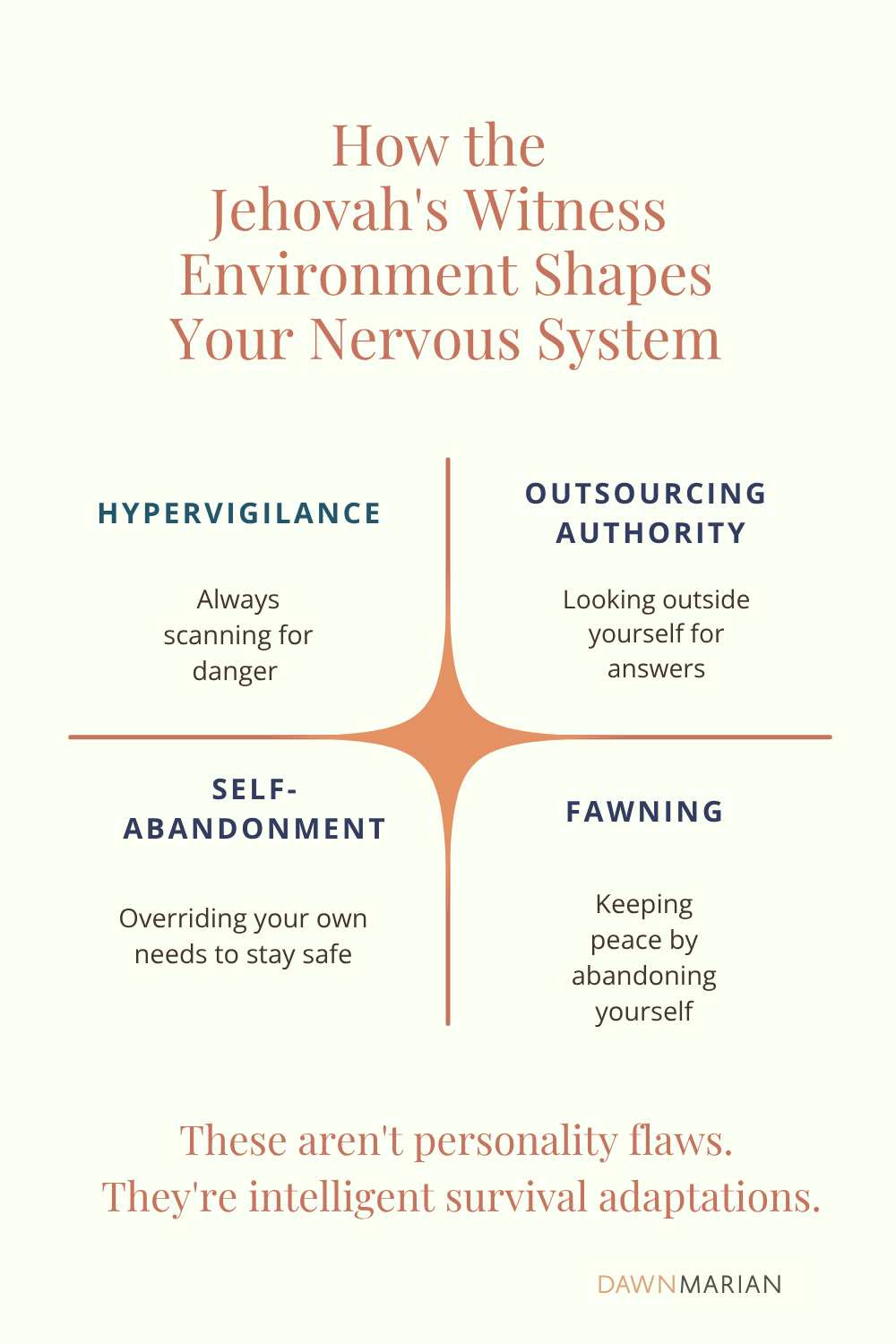
Common Nervous System Adaptations After Leaving Jehovah's Witnesses
Every nervous system adapts differently, and not everyone will relate to every example. These are some of the most common nervous system adaptations that can develop from living life as a Jehovah's Witness.
Hypervigilance
Inside the organization, obedience was mandatory, and staying safe meant staying vigilant. Your nervous system learned to constantly scan for danger.
You were taught to watch for:
- Satan's influence
- worldly influences and bad associations
- impure thoughts
- signs of Armageddon and persecution
- independent thinking
- disobedience
- what the elders thought of you
- whether Jehovah approved of you
- whether you were doing enough
Years later, that same adaptation may show up as:
- constant low-grade anxiety
- perfectionist tendencies
- feeling like you can never fully relax
- always waiting for something bad to happen
- constantly scrutinizing yourself
Outsourcing Your Inner Authority
Jehovah's Witnesses teach you to look outside yourself for answers.
You learned to:
- defer to the elders and the Governing Body
- pray for answers instead of trusting your instincts
- distrust your own heart
- disconnect from your body's wisdom
- research the Society's position before making your own decisions
Your nervous system learned:
"I am not safe trusting myself."
Years later, that may look like:
- trouble making decisions or chronic indecision
- freezing when new opportunities present themselves
- constantly second-guessing yourself
- looking to others before trusting your own judgment
- constantly seeking validation
- difficulty knowing what you really want
Fawning
Inside the organization, qualities such as being meek, humble, agreeable and self-sacrificing were highly valued. Your nervous system learned that staying safe meant accommodating others.
You were taught to:
- put Jehovah's needs before your own
- put the needs of the congregation before your own
- avoid conflict
- be agreeable and cooperative
- give generously of your time and energy
- put the interests of others first
Years later, that same adaptation may show up as:
- keeping the peace at all costs
- chronic people-pleasing
- over-giving
- difficulty setting boundaries
- taking emotional responsibility for other people
- burnout from constantly putting yourself last
Self-Abandonment
Jehovah's Witnesses teach you to live in opposition to yourself. Your humanity is accepted only when it serves the organization.
You were taught to:
- question your own heart
- distrust your own mind
- suppress your doubts
- disconnect from your body
- deny your own needs and desires
- repress your sexuality
- put Jehovah's will before your own
- put the organization's expectations ahead of your own
- avoid emotions that might weaken your faith
- let go of dreams that conflicted with "the Truth"
Your nervous system learned that staying safe meant overriding and eventually abandoning parts of yourself.
Years later, that same adaptation may show up as:
- harsh self-criticism
- chronic self-doubt
- difficulty advocating for yourself
- difficulty receiving
- feeling guilty when you experience joy, pleasure or ease
- abandoning your own dreams
- self-sabotage
- deep-rooted resentment
- anger that is difficult to express
My Story
I had been out of Jehovah's Witnesses for decades.
I had untangled the belief systems. I had built a life that felt like my own. I knew who I was.
Then one day, during a Reiki healing session, the practitioner said something that completely shocked me.
"Your body is in a constant state of survival."
My first thought was, Wait... what? I've done so much healing. How is that possible? 😳
But I got curious and began to learn about the nervous system and the different survival states.
I started to see the adaptations my nervous system had made to stay safe as a Jehovah's Witness.
I was...
quick to assume blame, even when it wasn't true or necessary
sacrificing my own dreams for my partner
playing small in my business
struggling to have difficult but necessary conversations
constantly measuring myself against impossible standards and feeling like I was falling short believing I had to work hard and struggle if I wanted to be successful
This realization led me to somatic healing and eventually to Embodied Processing.
While my mind no longer believed the teachings of Jehovah's Witnesses and my heart had come to a place of peace with my past, my body was still living the way it had been conditioned as a little girl sitting in the Kingdom Hall.
I didn't need to heal more of my Jehovah's Witness experience.
I needed to help my body experience that it was finally safe to be free.

Learning to Feel Safe Again (Or Maybe for the First Time)
If all of this is new to you, you're not alone.
Most people are never taught about the nervous system and how intimately entwined it is with our life experiences. Jehovah's Witnesses are no exception.
Understanding how brilliantly your nervous system adapted to survive the difficult situations in your life is an important first step.
Healing begins by restoring the pathways of communication with your body and noticing what your nervous system is telling you.
This might look like simply paying attention to your body throughout the day.
What does your body feel like when you're walking in nature?
Sitting in heavy traffic?
Laughing with friends?
Watching a sad movie?
As you begin noticing how different environments affect your body, you begin rebuilding your connection with it. If this feels difficult, know that your ability to connect with your body is never lost. It's simply been buried beneath years of conditioning.
One of my favorite somatic practices is placing one hand on my heart and one hand on my belly, taking a few slow breaths and gently reminding my body:
"I'm safe."
"I'm here now."
The practice isn't about changing anything.
It's simply about being present.
As you reconnect with yourself and your body, you may discover there are parts of your experience that your body is still carrying. These experiences may benefit from working with a body-based approach such as breathwork, somatic healing, Tension & Trauma Releasing Exercises (TRE), Emotional Freedom Techniques (EFT, also known as tapping), trauma-informed yoga, ecstatic dance or Embodied Processing.
These somatic healing approaches create enough safety for the body to gently release stored stress and begin completing survival responses that were interrupted.
The good news is that your nervous system is adaptable. It's one of its greatest strengths. It got you this far.
Just as it learned to survive life inside Jehovah's Witnesses, it can also learn that it is safe to live in the present.
✦ The Heart of It
Your nervous system isn't broken. It adapted brilliantly to help you survive life as one of Jehovah's Witnesses.
Those adaptations are not who you are. They are learned survival responses that once helped keep you safe.
Just as your nervous system learned to survive, it can also learn that it is safe to be free.
✦ Continue Your Journey
If this article helped you understand your experience, here are a few places to continue:
Embodied Processing
If you recognize these survival patterns in yourself and you're ready to work directly with your nervous system, Embodied Processing offers a gentle, body-centered approach to helping the body release stored stress and complete interrupted survival responses.
→ Learn more about Embodied Processing
Reiki for Nervous System Regulation
If you're looking for a gentle introduction to nervous system healing, my Reiki for Nervous System Regulation class will help you understand how Reiki supports safety, regulation and reconnection with your body.
→ Explore the class