10 Common Jehovah's Witness Experiences That Can Create Trauma

If you're reading this, there's a good chance you (or someone you love) has been impacted by Jehovah's Witnesses and you want to make sense of the experience.
I was born into Jehovah's Witnesses and disfellowshipped when I was 19. Being disfellowshipped was heartbreaking, but I didn't really understand how traumatic Jehovah's Witness culture was until much later. Jehovah's Witnesses don't talk about trauma, and many experiences that would be considered harmful are normalized when you're living inside the organization.
In this article, we'll explore 10 common Jehovah's Witness experiences that can create religious trauma.
✦ In This Article
- Why experiences that were normal as a Jehovah's Witness may have had a deeper impact than you realized
- How fear, conditional belonging and external authority can affect your relationship with yourself
- How being taught to distrust yourself disconnects you from your own inner authority
- How recognizing what happened can become part of finding your way back to yourself
Not all ex-Jehovah's Witnesses will have experienced every situation on this list. Some will recognize only a few, while others may resonate with almost all of them.
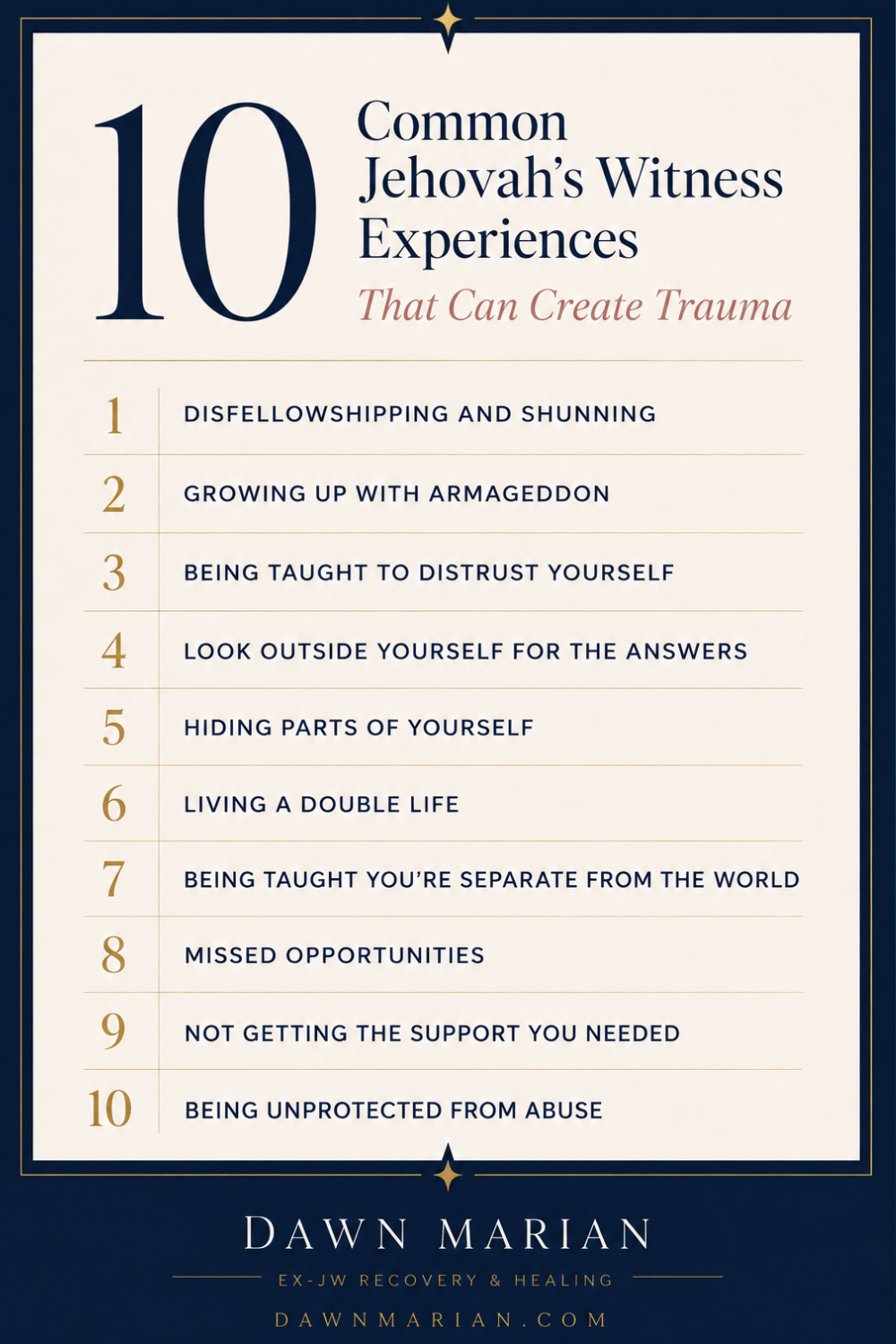
1. Disfellowshipping and Shunning
For many former Jehovah's Witnesses, disfellowshipping and the resulting practice of shunning is one of the deepest wounds they carry.
Whether you were disfellowshipped, chose to leave the organization by disassociation, or drifted silently away, your nervous system experienced a profound rupture in attachment.
Being on the receiving end of disfellowshipping and shunning can be devastating. But being told that you must cut off ties with friends or family who are no longer deemed acceptable to Jehovah because they have been disfellowshipped, publicly reproved, labeled as bad association or considered apostate can also be traumatic.
Often, the severance of ties can seem to come out of nowhere and happen overnight. One day, you’re making plans with your best friend, and the next, they’re gone and you can no longer speak to them. It’s a wound many ex-Jehovah’s Witnesses carry, whether we’ve been on the receiving or giving end of it.
Years later it may show up as unresolved grief, fear of rejection and abandonment, or anxiety about losing the people they love.
2. Growing Up with Armageddon
Jehovah's Witnesses constantly live with the threat of Armageddon looming over them. Graphically violent Watchtower illustrations depict the earth opening up, buildings collapsing, people crying out in terror and entire families being destroyed. This is accompanied by warnings from the Kingdom Hall stage about the inability to hide from the wrath of Jehovah.
The Watchtower and Tract Society's stance is that no one knows the day or time. This creates a culture of fear and vigilance in which one must always be prepared.
For children raised in the organization, there is an additional impact. Children don't have the developmental ability to separate symbolic teaching from real danger. Images of Armageddon, the prophecies of Revelation and repeated warnings about impending destruction can be experienced by a child's body as a very real threat.
For some former Jehovah's Witnesses, that early exposure can show up decades later as anxiety, nightmares, intrusive thoughts or a lingering sense that catastrophe is always just around the corner.
3. Being Taught to Distrust Yourself
Jehovah's Witnesses teach you not to trust yourself.
Your body is sinful. The flesh is weak. Your heart is treacherous. Even your own thoughts can lead you astray.
You are admonished to constantly monitor yourself for signs of wrongdoing, impure thoughts or drifting away from Jehovah.
Underneath all of this is the message that you are inherently flawed, incapable of thinking for yourself, and to not trust your experience.
4. Look Outside Yourself for the Answers
While Jehovah's Witnesses are dismantling your connection to your own internal wisdom, they are positioning themselves as the ones with the answers and the truth.
As a result, you learn to constantly look outside yourself for answers instead of going inward.
What does Jehovah want?
What does the Bible say?
What does the organization say?
What do the elders recommend?
Curiosity and free thinking are discouraged and can even be punishable. There are consequences for questioning authority or being independent.
With time, you can come to believe that you are incapable of making your own decisions without someone or something outside of you telling you what is right.
Together, these teachings create a severance between you and yourself. You become disconnected from your own internal wisdom, your right to think and act for yourself and ultimately, your sovereignty.
5. Hiding Parts of Yourself
Being in Jehovah's favor and belonging to the group comes with conditions.
Jehovah's Witnesses are taught how a good Christian should think, act and live. There are expectations around nearly every area of your life and clear messages about what is and isn't acceptable.
Anything within you that doesn't fit those expectations has to be hidden or shut down. This might include your questions and doubts, parts of your personality, your creative passions, your sexuality or gender identity.
You learn to constantly edit yourself based on who you believe you should be. When you repeatedly hide, judge or shut down parts of yourself to survive, you can begin to lose touch with yourself altogether.
6. Living a Double Life
Sometimes the parts of yourself you've been suppressing don't stay hidden. You begin exploring or acting on the things you want while still doing what is expected of you.
There's the version of you that goes to meetings, comments, goes out in field service and does everything a good Witness is supposed to do.
Then there's the other secret life.
Watching movies or reading books you know aren't acceptable.
Looking at porn, drinking, smoking or using drugs.
Having friendships with worldly people.
Having a hidden romantic relationship or having sex.
Living a double life requires constant vigilance and creates chronic stress. You're constantly managing your secret life, monitoring how you show up as a Jehovah's Witness and worrying about whether you're going to be exposed.
For those who get disfellowshipped because of a double life, you may internalize the idea that you are bad, selfish, rebellious and deserve to be punished. Guilt can linger for decades.
7. Being Separate from the World
As one of Jehovah's Witnesses, you're taught that you're separate from the world, but you still have to live in it.
You go to work. You go to school. You have neighbors. You go out in field service. In all of these places, you're identified as different.
People can be rude or hostile to Jehovah's Witnesses, especially during door-to-door work. Jehovah's Witnesses are also frequently the butt of jokes in popular culture. Non-believing family members may ridicule you for your beliefs.
You may even feel persecuted (and expect it, as per JW teachings).
If you grew up as a Jehovah's Witness, the wound can go even deeper because you're experiencing this separation from others as a child.
Not celebrating birthdays.
Leaving the classroom during holiday parties.
Not saluting the flag.
Being teased or bullied.
Feeling like the weird kid or a freak.
When you're taught that you're separate from the world and your experiences repeatedly reinforce that you're different, you can begin to internalize that difference as something being wrong with you. You may also begin to expect social interactions to be difficult or unsafe, an expectation that can continue even after you leave Jehovah's Witnesses.
8. Missed Opportunities
Many former Witnesses carry grief over opportunities they never felt free to pursue.
College.
A career they loved.
Creative passions.
Travel.
Relationships with people outside the organization.
Natural talents in academics, sports, the arts or other areas that were never developed.
Personal goals and dreams that were considered too worldly or not worth pursuing because Armageddon was believed to be so close.
There is trauma in repeatedly abandoning yourself and sacrificing what matters to you in order to remain within the norms of the congregation. There can also be tremendous grief and anger at the life you might have lived, what you may have become and the parts of yourself you never had the chance to fully explore.
9. Not Getting the Support You Needed
There is a cultural tendency within Jehovah's Witnesses to respond to personal problems by asking what you are doing wrong or what you could be doing differently.
Are you praying enough? Studying enough? Are you spiritually strong enough? Are you being submissive enough?
Someone struggling with depression or anxiety may be encouraged to pray more, study more or increase their spiritual routine instead of being encouraged to seek appropriate mental health care. A couple experiencing problems in their marriage may be encouraged to pray together, study together or focus on strengthening the spiritual side of the relationship instead of working on their problems. People experiencing financial hardship may be encouraged to trust in Jehovah, maintain their spiritual priorities and avoid becoming overly focused on material concerns.
When you're already hurting and reach out for help, only to have the responsibility for the problem placed back onto you, it can be deeply traumatic.
Over time, you may begin to internalize the message that something is wrong with you, that your needs don't matter or that you're not worthy of receiving support.
10. Being Unprotected from Abuse
Jehovah's Witness culture has historically minimized or ignored trauma and abuse rather than encouraging people to seek appropriate outside help.
Because of the two-witness rule, situations involving child abuse, sexual abuse or domestic violence can go unaddressed within the congregation when there isn't another person who witnessed what happened. Elders may know that something is happening, but without a second witness, no judicial action is taken.
There is also a strong emphasis on not bringing reproach on Jehovah's name, which can leave people reluctant to involve outside authorities or seek professional help.
Instead, victims may be encouraged to pray, rely on Jehovah, endure the situation or wait for the new system of things to make things better. Victims may also be gaslit, by asking what they did to contribute to the situation, and encouraged to be more submissive, take a humble approach, and give it to be resolved in Jehovah’s due time.
The trauma is compounded when you're left in a situation without protection, support or help from people who know you're suffering.
✦ The Heart of It
If you recognized yourself in these experiences, my heart goes out to you. I personally identify with every item on the list as part of my Jehovah's Witness upbringing. So many things that were considered normal within Jehovah's Witnesses can look very different when you begin to understand them through the lens of trauma.
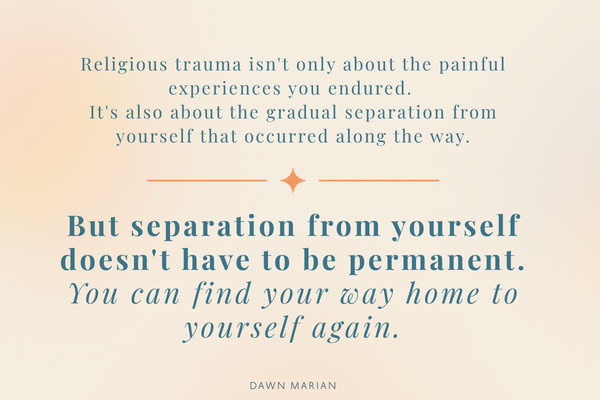
XJW Trauma isn't only about the painful experiences you endured as a Witness. It's also about the gradual separation from yourself that was required to be a Jehovah's Witness.
You were taught to distrust yourself. To look outside yourself for the answers. To hide or suppress parts of who you were. To sacrifice things that mattered to you in order to belong. And sometimes, when you needed help the most, you didn't receive it.
But separation from yourself doesn't have to be permanent.
Healing from Jehovah's Witnesses is the process of finding your way back.
Continue Your Journey
Connect with other former Jehovah's Witnesses who understand the unique experience of leaving and rebuilding your life after the organization.
→ Learn About the XJW Recovery Group
If you'd like more personalized support on your healing journey, explore the different ways we can work together.
→ Explore Ways to Work Together